


Introduction: The Crossroads of E-commerce in the Arab World
The Arab world is witnessing an unprecedented boom in the e-commerce sector, with the number of online stores growing rapidly year after year. This boom has created immense opportunities for entrepreneurs and project owners, but at the same time, it has presented them with a significant challenge: choosing the most suitable platform to launch and grow their stores. The correct choice of an e-commerce platform is the cornerstone upon which all success strategies are built, from the ease of product management to the final user experience. Available platforms differ significantly in their features, costs, level of customization they offer, and their scalability, making the selection process complex and requiring a deep understanding of the store's needs and future goals.
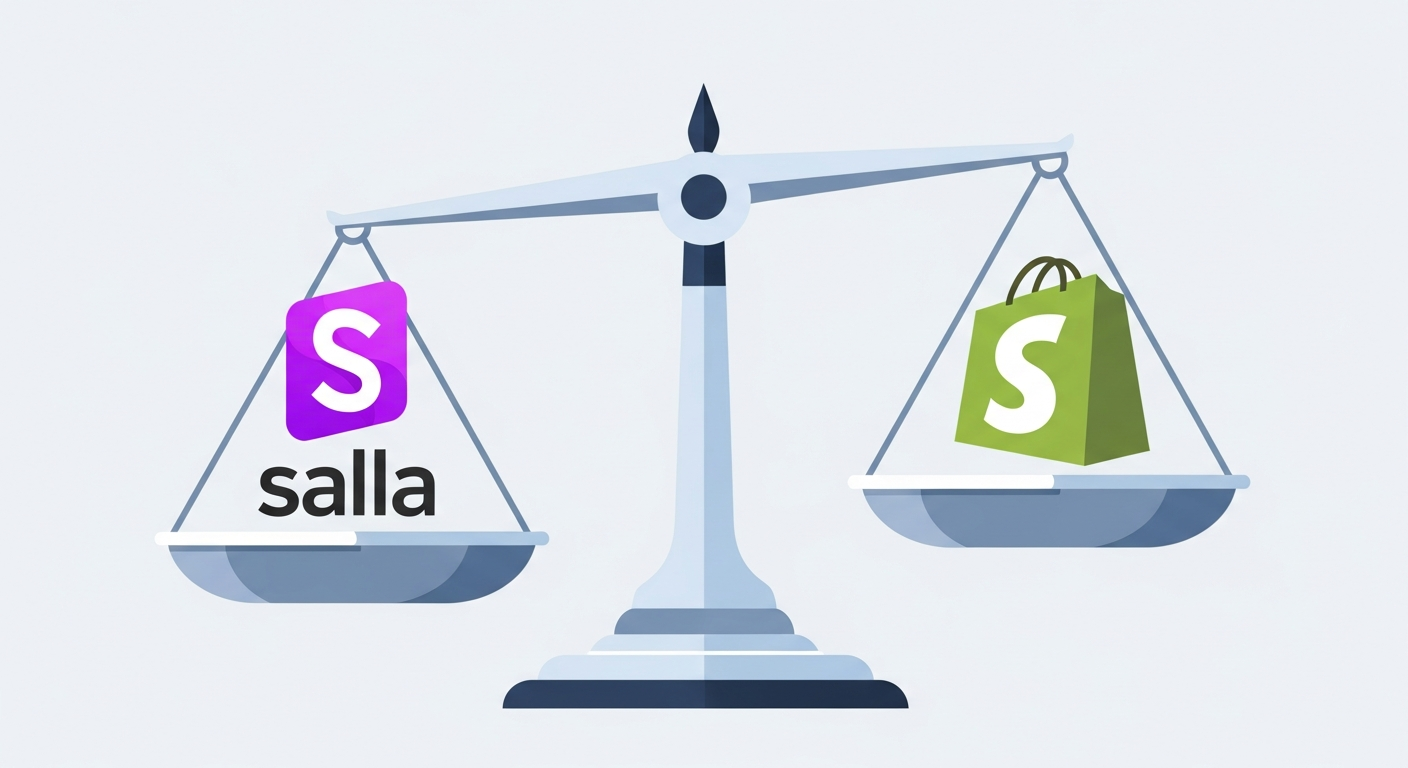
Amidst this diverse landscape, three main platforms dominate the e-commerce market in the region: Salla, Zid, and Shopify. Each stands out with unique characteristics that make it attractive to different categories of merchants. While Salla and Zid excel in providing integrated local solutions specifically designed for the Arab market, Shopify offers global flexibility and extensive customization capabilities. This article aims to delve into a comprehensive and detailed comparison between two of these leading platforms: Salla and Shopify. We will analyze every aspect of these two platforms, starting from ease of use and costs, through customization options and technical support, to provide a comprehensive guide that helps you make an informed decision about which is most suitable for your online store, whether you are just starting your project or looking to expand your current operations.
Understanding the Basics: Salla and Shopify at a Glance
Before diving into the comparison details, it is essential to understand the basic nature of both Salla and Shopify platforms. Salla is a Saudi-origin e-commerce platform established with the primary goal of simplifying the process of creating and managing online stores for merchants in the Arab world. Salla is characterized by an extremely intuitive user interface, full Arabic language support, and ready-made integrations with local payment gateways and shipping companies, making it an ideal choice for stores targeting the Saudi and Gulf markets in particular.
Salla is designed to be a comprehensive and straightforward solution, where merchants can start selling their products within minutes without needing any prior technical experience. The platform offers a wide range of ready-made templates that can be easily customized, in addition to basic marketing tools and inventory and order management. Salla's focus is on meeting the needs of the local market, providing technical support in Arabic, and offering a comfortable working environment that aligns with Arab business culture, thereby reducing the obstacles that new merchants might face when entering the e-commerce world.
On the other hand, Shopify is a Canadian-founded e-commerce platform with a vast global reach. Shopify is known for its immense power and flexibility, offering a comprehensive suite of tools and features suitable for small to medium-sized businesses and even large enterprises. The platform enables merchants to build professional and highly customizable online stores, with access to a massive app store containing thousands of add-ons that incredibly expand the store's functionalities, whether in marketing, inventory management, or customer service.
Ease of Use and User Interface
Ease of use is a crucial factor influencing the decision to choose an e-commerce platform, especially for beginners or small business owners who may not have extensive technical expertise. The Salla platform is characterized by its simple and intuitive design, which focuses heavily on providing a smooth user experience in Arabic. Anyone, even without prior experience in building online stores, can create their own store on Salla within minutes, easily adding products and managing orders, making it an attractive option for beginners.
Salla provides an organized and clear control panel, with simplified instructions for each step, significantly reducing the learning curve. This focus on simplicity and clarity is evident in every aspect of the platform, from initial store setup to daily operations management. Salla does not require knowledge of programming languages or complex design; instead, it relies on a drag-and-drop system and ready-made templates to facilitate the process as much as possible. This suits merchants who want to launch their store quickly and at a low cost without technical complications.
In contrast, Shopify offers a powerful and flexible user interface, which might be slightly more complex for beginners compared to Salla, but it provides significantly greater control and customization. Shopify requires some time to explore all its features and understand how it works, but once accustomed to it, you will find that it offers comprehensive tools to manage your store with high efficiency. Shopify allows users access to a vast learning academy and an active support community, which helps overcome any technical challenges they might face. This flexibility and power are at the core of the Shopify experience for stores aiming for growth and expansion.
Costs and Pricing Plans
Costs are a major factor in choosing an e-commerce platform, especially for startups with limited budgets. Salla offers a range of diverse pricing plans, starting from a free plan with limited features and scaling up to paid plans that offer more advantages, such as a larger number of products, more storage space, and advanced marketing features. Salla is characterized by its transparent cost breakdown, and its prices are often very competitive in the local market. Additionally, it does not impose transaction fees on sales except in certain specific plans or when using particular payment gateways, which reduces the operational costs for small stores.
In addition to monthly subscriptions, merchants on Salla may incur some additional costs related to paid apps in the Salla app store, or fees from integrated shipping companies and payment gateways. However, these costs are often reasonable and proportional to the volume of operations in the local market. Salla's pricing model offers great flexibility, allowing stores to start with a simple plan and then upgrade as their business grows, ensuring that costs always align with the size and scope of operations, making it an attractive economic option for many.
Conversely, Shopify relies on a subscription-based pricing model, starting from the Shopify Basic plan and escalating to Shopify and Advanced Shopify plans, up to Shopify Plus for very large enterprises. Shopify plans are characterized by advanced features and comprehensive support, but they may be more expensive than Salla, especially when adding transaction fees imposed by Shopify on each sale if Shopify Payments is not used, in addition to extra costs for paid apps from the Shopify App Store.
Customization and Design Options
The ability to customize an online store's design and user experience is a crucial factor in building a distinctive and appealing brand for customers. On Salla, the platform provides a good selection of ready-to-use, professional templates that merchants can choose from. These templates are designed to be responsive and work well across various devices, and they are easy to modify through the simple control panel. Merchants can easily change colors, fonts, add logos, and adjust basic sections to match their brand identity, allowing them to launch a professional-looking store without needing deep design expertise.
However, the customization options in Salla, despite their ease, may be relatively limited compared to more flexible platforms. Merchants looking for a very unique design or highly customized functionalities might find that Salla does not offer that level of deep control. The platform focuses on providing ready-made and quick solutions, which means there are limitations on fundamental template structure changes or adding complex features that require code modification. This suits most small and medium-sized stores that do not need excessive customization.
In stark contrast, Shopify excels in providing nearly limitless customization and design options. The platform offers a massive store of free and paid themes, covering a wide range of industries and styles. Merchants can extensively customize these themes through a visual theme editor, which allows easy modification of colors, fonts, layout, and section additions. For stores requiring deeper customization, Shopify provides access to the theme's code (using the Liquid templating language), opening the door for web developers to modify every aspect of the store and design a completely unique experience. This flexibility makes Shopify the preferred choice for stores with a specific design vision or needing custom functionalities not available out-of-the-box.
Apps and Integrations
Apps and integrations serve as the backbone that extends the functionalities of e-commerce platforms, enabling stores to add advanced features beyond the platform's basic capabilities. On Salla, there is a dedicated app store (Salla App Store) that includes a growing collection of apps and integrations specifically designed to meet the needs of the Arab market. These apps cover solutions for marketing, inventory management, customer service, analytics, and much more. These apps integrate seamlessly with the Salla platform and are characterized by ease of installation and use, adding significant value to stores without technical complexities.
One of the most prominent features of the Salla app store is its focus on integration with local and regional services. You will find apps for local payment gateways, Saudi and Gulf shipping companies, and marketing tools tailored for the Arab audience. This local integration saves merchants the trouble of searching for external solutions that may not be fully compatible with their needs or might require complex modifications. Although the number of apps on Salla might be fewer compared to Shopify, their quality and suitability for the target market make them highly valuable for stores operating in the region, especially those seeking to streamline their operations and benefit from local solutions.
In contrast, Shopify boasts an enormous app store (Shopify App Store) containing tens of thousands of apps and integrations, covering every conceivable function, from advanced marketing tools and SEO to complex inventory management and customer service systems, and even multi-channel delivery and retail solutions. This massive store provides merchants with unparalleled flexibility to expand their functionalities and customize their experience to meet any business requirements, regardless of their size or complexity. Many apps rely on monthly subscription models, which means costs can increase as more advanced add-ons are included.
Payment and Shipping Gateways
Payment gateways and shipping companies are among the most important pillars for the success of any online store, directly influencing customer experience and trust in the store. On Salla, the focus is on providing seamless integrations with the most popular local payment gateways in Saudi Arabia and the Gulf, such as Mada, Visa, Mastercard, Apple Pay, in addition to Cash on Delivery (COD) options, which are still preferred by a large segment of shoppers in the region. These ready-made integrations simplify payment acceptance for merchants and offer multiple options for customers, increasing the chances of sales completion. For more details on this aspect, you can refer to our article on Payment Gateways: Your Guide to Choosing the Best in Salla and Zid.
In addition to payment gateways, Salla provides strong integrations with leading local shipping companies in Saudi Arabia and Gulf countries, such as Aramex, SMSA, and many others. These integrations allow stores to easily manage shipping operations, print shipping labels, and track orders directly from the Salla control panel. This focus on local solutions makes Salla an excellent choice for stores targeting the regional market, as it provides an integrated working environment that aligns with the logistical and payment conditions in the region, reducing operational complexities and offering a smooth experience for both merchant and customer.
On the other hand, Shopify offers a very wide range of global payment gateways, including Shopify Payments (its own payment gateway), PayPal, Stripe, and many others. This diversity allows stores to reach customers from all over the world and offer their preferred payment options. However, the availability of some local payment gateways in the Arab region may vary, and it might require manual integration or through third-party apps. Transaction fees are also an important point to consider with Shopify, as it imposes additional fees on each transaction if Shopify Payments is not used, which can affect profit margins.
Arabic and English Language Support
Language support is a vital factor for stores targeting an Arab audience or seeking to expand into multilingual markets. Salla excels in this aspect by providing full and native support for the Arabic language in every aspect of the platform, from the user interface and control panel to the ready-made templates. Salla was designed from the ground up with the needs of the Arab market in mind, meaning that all texts, settings, and menus are available in clear Modern Standard Arabic by default and seamlessly, without the need for any additional translations or manual adjustments. This ensures a comfortable and efficient user experience for Arabic-speaking merchants and customers.
In addition to excellent language support, Salla also naturally provides Right-to-Left (RTL) support, which is critically important for Arabic website design. This deep integration of the Arabic language and RTL support ensures that the online store is professional and appealing to the Arab audience, and significantly enhances the user experience. Stores on Salla can easily create Arabic content, add product descriptions in Arabic, and interact with customers in the same language without any barriers, making it the ideal choice for stores primarily focused on the Arab market and considering Arabic as a core identity for their brand.
As for Shopify, it offers strong support for multiple languages, including Arabic, but it may require some effort to set up completely. The core platform and user interface are available in English, and other languages can be added through translation apps or theme modifications. Although Shopify supports Right-to-Left (RTL) in many of its themes, achieving seamless and aesthetically pleasing Arabic integration might require some customization or the use of themes specifically designed for Arab markets. Large global stores can leverage this flexibility to offer their stores in multiple languages, but merchants focusing exclusively on the Arab market might find the process of setting up Arabic on Shopify more complex than Salla, as it is not fully integrated by default.
When to Choose Salla?
Choosing Salla as your e-commerce platform is optimal in several specific scenarios, especially if you are focused on the local market and prefer simplicity and integrated solutions. If you are a beginner merchant or have a small project with a limited budget, Salla offers an excellent starting point. Its intuitive interface and easy store setup mean you won't need prior technical experience, and you can start selling your products quickly and without complications. Salla's low costs and flexible pricing plans make it a very economical option for startups that need to control initial expenses.
If your primary focus is on the Saudi or Gulf market, Salla is undeniably the best choice. The platform has been specifically designed to meet the needs of this market, from native Arabic language support and local integrations with payment gateways and shipping companies, to a technical support team that speaks your language and understands your local challenges. These advantages provide you with an integrated and comfortable working environment, ensuring a smooth experience for your local customers, which enhances your chances of success in the region and facilitates daily operations without any cultural or technical barriers.
Finally, if you are looking for a simple, integrated solution that doesn't require you to delve into complex technical details or extensive customizations, Salla provides everything you need to launch a professional and effective store. The platform focuses on offering strong fundamentals with ease of use, allowing you to concentrate on your core business of selling products and serving customers, instead of spending time managing technical aspects. It is the ideal choice for stores that value efficiency and speed in execution and prefer ready-made solutions that work well in their local environment.
When to Choose Shopify?
In contrast, Shopify is the ideal choice for stores looking to grow on a large scale and requiring advanced flexibility and customization capabilities. If you have a vision for global expansion or target multilingual markets, Shopify provides the robust infrastructure to support such ambitions. Its ability to handle multiple currencies, global payment gateways, and different languages (with some customization) makes it an ideal platform for reaching a wide customer base worldwide and expanding your operations without geographical constraints.
If your store requires deep design and functional customizations, or if you wish to build a completely unique brand that necessitates code modifications or integration with complex external systems, Shopify is the platform that offers you this flexibility. Its massive app store and access to theme code give you the ability to build a store that perfectly aligns with your vision. This customization capability makes Shopify the preferred choice for stores with unique requirements or needing to add advanced features not natively available on other platforms.
Finally, if you are looking for a highly scalable platform that offers advanced marketing and analytical tools to support your business growth in the long term, Shopify provides this solution. With its diverse plans suitable for businesses of all sizes, and its ability to handle a very large number of products, orders, and visitors, Shopify ensures that your store can grow with you without needing to switch to another platform in the future. It is a long-term investment in a robust and reliable infrastructure that supports your ambitious business goals and helps you achieve maximum growth potential and profitability.
Conclusion: A Strategic Decision for Your Store's Success
Ultimately, there is no single 'best' option between Salla and Shopify; rather, there is the 'most suitable' choice for your specific store, which largely depends on your individual needs, business goals, budget, and the market you are targeting. In this article, we have reviewed the essential aspects of both platforms, from ease of use and costs, through customization options and language support, to marketing tools and technical support, clarifying the optimal usage scenarios for each. Understanding these differences is the first step towards making an informed decision that serves your business interests in the long run.
If you are a beginner merchant or own a small project primarily targeting the Saudi or Gulf market, and you are looking for a simple, easy-to-use, locally integrated solution at a reasonable cost, then Salla will be your optimal choice. Salla will provide you with a comfortable working environment in Arabic, ready-made integrations with local payment gateways and shipping companies, and technical support that understands your needs. However, if you are looking to expand globally, have advanced and complex customization requirements, or need a wide range of apps and integrations to enhance your store's functionalities, and you have a budget that allows investment in these features, then Shopify will provide you with the necessary power and flexibility to achieve your global ambitions.
Therefore, before making your final decision, we advise you to carefully evaluate your store: What are your short-term and long-term goals? Who is your target audience? What is your available budget? And what level of technical control do you prefer? Do not hesitate to try both platforms if possible, as most offer free trial periods that allow you to explore features and familiarize yourself with the user interface. Remember that choosing an e-commerce platform is a strategic decision that affects every aspect of your business, so make it a well-considered choice based on a deep understanding of your needs to ensure your store's success in the growing world of e-commerce.