


Introduction: The Key to Success in the E-commerce World
In the rapidly evolving world of e-commerce, merely owning an online store is no longer enough to guarantee success and achieve desired sales. With the increasing number of stores and market competitiveness, making your products visible to potential customers has become both the biggest challenge and a golden opportunity. Imagine having the highest quality and most innovative products, but no one can find them; this is precisely what happens when you neglect Search Engine Optimization (SEO) for your products. Product SEO is not just a complex technical term; it is a vital strategy that ensures your products do not get lost in the vast ocean of the internet, but rather stand out and reach their target audience.
Platforms like Salla, Zid, and Shopify are powerful tools for creating and managing online stores, but true success lies in how you leverage these platforms to increase your product visibility. Product SEO is the backbone that elevates your product pages' ranking in search engine results like Google, which means more free organic traffic to your store, and consequently, increased conversion opportunities and sales. In this comprehensive article, we will delve into effective product SEO strategies and how you can intelligently apply them to your Salla, Zid, and Shopify stores to ensure maximum visibility and reach.
Understanding Product SEO and Its Importance for Your Online Store
Product SEO, or Search Engine Optimization for products, is a set of practices and strategies aimed at making your product pages more appealing to search engines, thereby improving their ranking in organic search results. When a potential customer searches for a specific product using particular keywords, the goal is for your products to appear at the top of the results, increasing the likelihood of them being clicked and your store being visited. This is not limited to written content; it also includes technical aspects, user experience, product images, and other elements that search engines consider indicators of quality and relevance.
The importance of product SEO lies in its ability to provide free and continuous traffic to your store. Unlike paid advertisements that stop once the budget runs out, SEO efforts continue to bring visitors over the long term, making it a sustainable and cost-effective investment. In a competitive environment like the Arabic e-commerce market, which uses platforms such as Salla, Zid, and Shopify, excelling in product SEO becomes a crucial factor for survival and growth, ensuring you a larger share of the search market and broader access to your customers.
Furthermore, product SEO is not just about bringing visitors; it also contributes to building trust and credibility for your store. When your products appear at the top of search results, it grants them a certain authority and reliability in the eyes of customers, increasing the likelihood of completing a purchase. This integrated strategy ensures that your products are not only visible but also appealing and convincing to the audience actively searching for them, turning simple searches into real sales.
Keywords: The Cornerstone of Product SEO
Keywords are the foundation upon which any successful SEO strategy is built, and in the context of product SEO, they gain double importance. Keywords are the phrases potential customers use to search for the products you offer. Understanding and intelligently using these keywords is what connects your products to those searching for them. Without the right keywords, your content optimization efforts will be like building on quicksand, and search engines will not be able to understand the context of your products and present them to the right audience.
Keyword research is not just guesswork; it is a systematic process that requires tools and careful analysis. You should look for keywords that have good search volume while also being directly relevant to your products and accurately describing the searcher's intent. For example, if you sell 'men's sports shoes,' keywords like 'men's running shoes' or 'comfortable men's athletic shoes' might be more specific and appealing to customers ready to buy compared to the general word 'shoes.' This focus helps attract the most qualified visitors who are most likely to convert.
When you naturally and intelligently integrate keywords into all elements of a product page, you send strong signals to search engines about your page's content. It is crucial to avoid keyword stuffing, as this can lead to negative results and penalties from search engines. Instead, focus on creating valuable, informative content that uses keywords in a natural context that is helpful to the customer. This balance between search engine requirements and user experience is the key to a successful keyword strategy.
Relevant Keyword Research
To successfully begin your product SEO journey, your keyword research must be comprehensive and precise. Start by thinking like a potential customer: what phrases would you type into a search engine if you were looking for your products? Use keyword research tools like Google Keyword Planner, Semrush, Ahrefs, or even built-in search tools in some e-commerce platforms like Shopify that offer valuable insights. These tools not only give you keyword ideas but also provide data on search volume and competition, helping you make informed decisions.
Pay particular attention to long-tail keywords, which are search phrases consisting of three or more words and are more specific. For example, instead of targeting 'dress,' you could target 'long blue evening dress plus size.' These keywords are often less competitive and have higher purchase intent, meaning they attract customers looking for something very specific and who are close to making a buying decision. Targeting these keywords can lead to significantly higher conversion rates, even if their search volume is lower.
Don't forget to also analyze the keywords your competitors are using. You can use competitor analysis tools to see which keywords they rank highly for, giving you valuable insights for your own strategy. Additionally, explore forums, social media groups, and customer reviews to find terms and questions customers use when talking about products similar to yours. These sources provide a deeper understanding of customer language and preferences.
Effective Keyword Integration
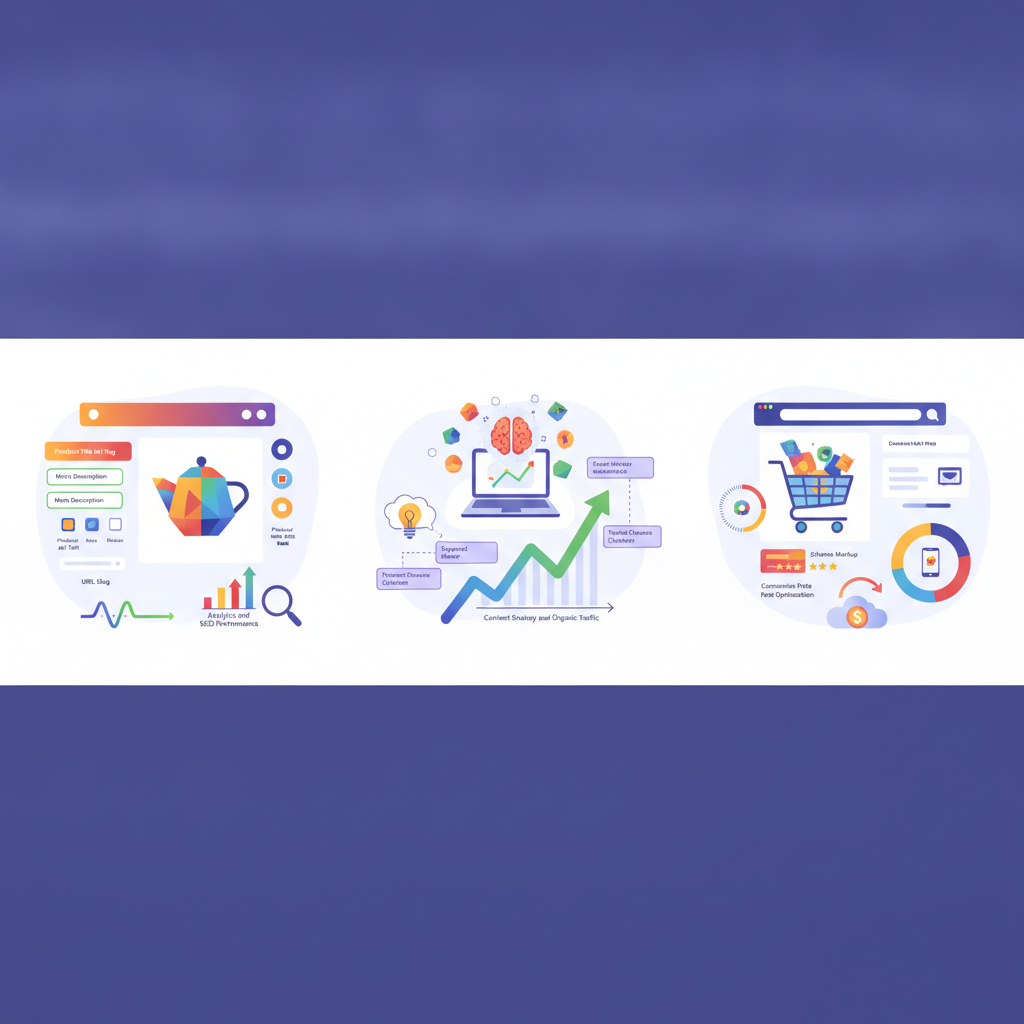
Once you have a strong list of target keywords, the next step is to effectively integrate them into your product pages without overusing them or making the content sound unnatural. Keywords should be present in the most important places that search engines pay attention to, such as the product title, description, meta description, and image alt text. Remember that the goal is to help search engines understand your page's content, while also providing a smooth and useful reading experience for your customers.
Start by placing the primary keyword in the Product Title as early as possible. On platforms like Salla, Zid, and Shopify, you can easily edit product titles to include your chosen keywords. Then, naturally incorporate secondary or related keywords into the product description, focusing on explaining the product's benefits and features. Use them in paragraphs and subheadings (if any) to increase topical relevance. For more tips on overall store optimization, you can check out our article on Conversion Optimization: Boosting Sales in Your Salla and Zid Store, which offers additional strategies for increasing your sales.
The meta description is just as important as other elements. Although it does not directly affect ranking, it significantly impacts the click-through rate (CTR). Write an attractive meta description that includes the primary keyword, concisely summarizes the page content, and encourages users to click. Remember that the meta description appears below the title in search results, and it's your chance to entice customers. Finally, do not neglect image Alt Text; it provides a text description of images for search engines and helps improve your products' visibility in image search as well.
Optimizing Product Pages: Details That Make a Difference
After identifying and integrating keywords, the focus shifts to optimizing other elements of the product page itself. These details, no matter how small they seem, can make a significant difference in how search engines index your page and how visitors interact with it. From descriptive titles to image quality, every element plays a role in enhancing product SEO and user experience. The goal is to create product pages that are informative, visually appealing, and technically optimized, satisfying both search engines and customers.
Remember that search engines constantly strive to provide the best user experience, meaning product pages that offer comprehensive, clear, and easy-to-use information will be favored over those lacking these aspects. This includes ease of navigation, page loading speed, and mobile compatibility. The better your product page is at presenting information and meeting customer needs, the higher its chances of ranking higher in search results. This holistic view of page optimization is what distinguishes successful stores from others.
On platforms like Salla, Zid, and Shopify, many tools and features are provided to facilitate the product page optimization process. From dedicated fields for titles and descriptions to capabilities for uploading multiple images and managing reviews, you can leverage these tools to create fully optimized product pages. Invest time in understanding how these features work and use them effectively to enhance your product SEO, and don't hesitate to regularly update your product pages based on their performance and search analytics.
Product Titles
The product title is the first thing customers and search engines see. It must be engaging, descriptive, and contain the primary keyword. On platforms like Salla, Zid, and Shopify, you can easily control your product titles. Make them clear and concise, yet rich enough to accurately describe the product. For example, instead of 'Shirt,' you could use 'Men's Casual Cotton Blue Light Shirt - Size L.' This title combines the main keyword (men's shirt) with important details (cotton, casual, light blue, size L) that customers might search for.
When crafting product titles, consider how customers use terminology. Do they use the brand name? Do they mention color, size, or material? Try to integrate these details naturally. Remember that search engines truncate long titles, so place the most important keywords at the beginning. Use commas or hyphens to break up information and make the title easy to read. The more accurate and comprehensive the title, the higher its chances of appearing in specialized searches.
Avoid vague or exaggerated titles that do not provide real value to the customer. The goal is to inform the customer and search engines exactly what the product is. In the context of Arabic e-commerce, ensure you use clear, standard Arabic and common terms, taking into account subtle differences in terminology if any. This ensures your product title is understandable and effective in attracting the target audience.
Product Descriptions
The product description is your opportunity to sell the product to the customer and convince search engines of its relevance. The description must be unique, detailed, engaging, and keyword-rich. Do not merely copy and paste supplier descriptions; this harms your store's SEO due to duplicate content. Instead, write an original description that highlights the product's benefits and how it solves customer problems or meets their needs. Use persuasive and clear language, and break the description into short paragraphs and subheadings for easy readability.
Ensure you include all important details such as dimensions, materials, features, uses, and any special instructions. Think about the questions customers might have about the product and answer them in the description. For example, if you are selling an electronic product, mention compatibility with other devices, battery life, and warranty. The more detailed and comprehensive the description, the greater the chance of the customer staying on the product page and increasing the likelihood of purchase. For more ideas on how to attract customers, you might find the article Product Pricing: Smart Strategies for Salla and Zid Stores useful in understanding how to convert visitors into buyers.
Naturally use the keywords you researched throughout the description, including in subheadings and bullet points. Do not overstuff keywords; instead, focus on the value the product offers. You can also include small stories or usage scenarios for the product to make the description more engaging and interactive. Remember that the goal is not just to inform the customer, but to inspire them and illustrate how the product can improve their life or fulfill their desires.
Product Images and Videos
High-quality images and videos are essential not only for visually attracting customers but also for improving your product SEO. Search engines cannot 'see' images, but they rely on Alt Text (alternative text) to understand their content. Make sure to use descriptive and keyword-rich Alt Text for every product image. For example, instead of 'image1.jpg,' use 'Blue Nike Men's Running Shoe for Walking.' This helps your products appear in image search results and improves accessibility for visually impaired users.
Beyond Alt Text, pay attention to image size and quality. Very large or unoptimized images can slow down the product page loading speed, which is an important factor in SEO and user experience. Use image compression tools to reduce file size without sacrificing quality. On platforms like Salla, Zid, and Shopify, there are often built-in features for automatic image optimization, but it's always good to manually check. Provide multiple images of the product from different angles, close-ups, and images of the product in use to give customers a comprehensive view.
Don't hesitate to add product videos if possible. Video increases visitor stay time on the page, which is a positive indicator for search engines, and it significantly enhances the user experience. Videos can demonstrate how to use the product, offer a quick review, or even show it in a real-world context. Ensure you optimize video titles and descriptions with appropriate keywords and host them on platforms like YouTube for maximum reach.
Customer Reviews and Testimonials
Customer reviews and testimonials are a true treasure for product SEO and increasing sales. Firstly, these reviews provide unique and fresh content for your product pages, which search engines favor. Reviews often contain natural keywords used by customers, enhancing your page's search relevance. Secondly, reviews serve as powerful social proof that builds trust and credibility with potential customers, leading to higher conversion rates. Consider how this impacts a purchase decision when a customer sees that your product is highly rated by others.
Actively encourage your customers to leave reviews after purchase. You can send follow-up emails or offer small incentives like discounts on future purchases. On Salla, Zid, and Shopify platforms, there are built-in features for managing and displaying customer reviews, making this process easier. Ensure reviews are clearly displayed on product pages, and respond to reviews, whether positive or negative; this shows your commitment to customer service and enhances your brand image.
In addition to boosting SEO, reviews provide valuable feedback on your products and services. You can use this feedback to improve your products, refine their descriptions, or even discover new keywords customers might be using to describe your products. Negative reviews, though potentially discouraging, are an opportunity to demonstrate transparency and commitment to problem-solving, which can turn a negative experience into a chance to build customer loyalty.
Technical and Advanced Product SEO Optimization
Beyond content, technical aspects play a crucial role in product SEO. Search engines not only look at what is on the page but also how that content is presented and how the page interacts with users. Technical optimization ensures that search engines can crawl and index your product pages efficiently and provides a smooth user experience, directly impacting your ranking. Neglecting these aspects can hinder your product SEO efforts even if the content is excellent.
Page loading speed and mobile compatibility are among the most important technical factors affecting SEO and user experience. In today's world, customers expect fast-loading pages, especially when shopping online. If your product pages take too long to load, customers are likely to leave before they can even see your products, increasing bounce rates and hurting your search engine ranking. Platforms like Salla, Zid, and Shopify are usually optimized for speed, but you can still take additional steps to ensure optimal performance.
Structured Data and internal links are also powerful technical elements that can significantly boost your product SEO. Structured data helps search engines better understand the context of your products and display them attractively in search results, such as showing reviews and prices directly. Internal links, on the other hand, enhance site structure and distribute SEO value across different pages. These technical aspects, when implemented correctly, can give your store a significant competitive advantage.
Page Loading Speed and User Experience
Product page loading speed is not just a luxury; it is a critical necessity in the world of e-commerce. Studies have shown that every additional second in load time can significantly reduce conversion rates. Search engines like Google favor pages that load quickly because they provide a better user experience. On Salla, Zid, and Shopify platforms, you can improve loading speed by ensuring that product images are optimized (compressed), using responsive templates, and minimizing the number of unnecessary plugins that might slow down the site.
In addition to speed, overall user experience (UX) plays a vital role. Your product pages should be easy to navigate, with clear calls-to-action, and clear product information. Ensure your store is fully mobile-compatible, as a large number of customers shop using their smartphones. Responsive design ensures that your product pages are displayed correctly and attractively on any screen size, improving your store's SEO and preventing the loss of potential customers.
Use tools like Google PageSpeed Insights or GTmetrix to analyze your product pages' performance and get specific recommendations for improvement. Pay attention to recommendations such as reducing HTTP requests, optimizing server response, and leveraging browser caching. The better and faster the user experience, the longer visitors stay on your store, and the lower the bounce rate, sending positive signals to search engines and contributing to higher rankings.
Structured Data / Schema Markup
Structured Data, also known as Schema Markup, is additional code you can add to the HTML of your product pages to help search engines better understand the page content. For example, you can use Schema Markup to indicate that a specific page is a product page, specifying its name, price, ratings, and availability in stock. This does not directly affect ranking, but it can lead to the appearance of 'Rich Snippets' in search results, such as displaying star ratings and price directly below your page title.
Rich snippets are highly attractive and significantly increase the click-through rate (CTR) of your product pages, even if your actual ranking doesn't change. When a customer sees product ratings and prices directly in search results, they get valuable information even before visiting the page, increasing the likelihood of clicking if the information is appealing. On platforms like Shopify, there are often apps or themes that provide built-in support for product structured data. For Salla and Zid, you might need to check available features or use custom solutions if you want to implement Schema data advancedly.
When applying structured data, ensure you use the correct types such as `Product`, `Offer`, and `AggregateRating` to accurately describe your products. You can use Google's Structured Data Testing Tool to validate your markup and ensure it is being correctly interpreted by search engines. This extra effort can give your products a clear competitive advantage in search results, making them stand out and attract more attention. You might also find our article on Salla, Zid, and Shopify: Which is Best for Your Store? helpful in understanding platform capabilities.
Internal and External Links
Internal and external links play a pivotal role in boosting product SEO. Internal links are links connecting different pages within your online store. These links help search engines understand your site's structure, distribute SEO 'power' (link equity) between pages, and guide visitors to relevant content. For example, you can link related products to each other, or link a product page to a category page, or link blog articles to product pages they discuss. This enhances the authority of product pages and makes them more discoverable.
When building internal links, use descriptive anchor text that contains relevant keywords. For example, if you are linking to a 'sports shoes' page, make the anchor text 'trendy sports shoes' instead of 'click here.' This helps search engines understand the content of the target page. Links should be natural and useful to the user, not just keyword stuffing. You can leverage blog articles to create strong internal links to your products, such as an article discussing 'best Eid gifts' and linking to appropriate products.
External links (Backlinks), on the other hand, are links pointing to your product pages from other websites. High-quality backlinks from authoritative and trusted websites are among the strongest ranking factors in SEO. The more high-quality backlinks pointing to your product pages, the more authority these pages gain in the eyes of search engines. Building backlinks can be done through influencer collaborations, listings in business directories, or getting media coverage for your products. Remember that the quality of links is far more important than their quantity. For more strategies on enhancing visibility, consider checking out our guide on Google Ads: Strategies for Your Salla and Zid Store, which complements organic SEO efforts.
Performance Monitoring and Continuous Improvement
Product SEO is not a one-time process; it is an ongoing effort that requires continuous monitoring, analysis, and periodic adjustment. Search behavior changes, search engine algorithms evolve, and new keywords constantly emerge. Therefore, you must stay up-to-date with your products' performance in search engines and be ready to make necessary adjustments to maintain or improve your ranking. This flexibility and adaptability are what characterize successful SEO strategies in the long run.
Utilize the analytical tools available to you, such as Google Analytics and Google Search Console, to understand how customers interact with your product pages and how they arrive at them. These tools provide valuable insights into the keywords that bring visitors, the most visited pages, and bounce and conversion rates. By analyzing this data, you can identify strengths and weaknesses in your product SEO strategy and determine areas that need improvement.
Don't be afraid to conduct A/B testing on different elements of your product pages, such as titles, descriptions, and images. You might discover that a minor change in title wording or using a different image can significantly impact click-through rates or conversion rates. Continuous improvement based on data and experimentation is key to staying ahead of the competition and ensuring the continued success of your online store.
Analytics Tools (Google Analytics, Search Console)
Analytics tools like Google Analytics and Google Search Console are indispensable for any effective product SEO strategy. Google Analytics gives you a comprehensive overview of visitor behavior in your store, including the number of visitors, most visited pages, time spent on page, and bounce rates. You can track customer journeys from the landing page to completing a purchase, helping you understand where friction points or lost opportunities might occur. By linking Google Analytics to your Salla, Zid, or Shopify store, you can get accurate data on each product's performance.
Google Search Console, on the other hand, is a powerful tool focused on your store's performance in Google search results. Search Console allows you to see which keywords your products appear for, the number of impressions, click-through rate (CTR), and average ranking. It also alerts you to any technical issues that might affect the indexing of your product pages, such as crawl errors or structured data problems. Using these two tools together provides you with a complete picture of your product SEO performance and helps you make informed decisions.
Use these tools to identify pages that need improvement. For example, if you notice that a particular product page has a high number of impressions but a low click-through rate, it might indicate that the product title or meta description is not appealing enough. Or if a page gets a lot of traffic but has a high bounce rate, it might suggest that the page content does not meet visitor expectations. Regularly analyzing this data will help you prioritize your optimization efforts and focus them on areas that will have the greatest impact.
Experimentation and Testing (A/B Testing)
A/B testing is the process of comparing two versions of a webpage (A and B) to see which one performs better. In the context of product SEO, you can use A/B testing to test different elements of your product pages to see what improves click-through rate (CTR) or conversion rate. For example, you can test different product titles, different versions of product descriptions, or even alternative product images. The goal is to identify changes that positively impact user behavior and consequently SEO performance and sales.
On platforms like Shopify, there are many apps that facilitate A/B testing. For Salla and Zid, you might need to use external tools like Google Optimize (before its deprecation) or similar tools. When conducting an A/B test, make sure to change only one element at a time so you can identify the variable that made the difference. For example, if you are testing a product title, keep the rest of the page elements the same. Divide your audience into two groups, show each group a different version of the page, and then analyze the results to determine the winning version.
Experiments are not limited to obvious improvements; you can also test small details like the color of the buy button, the placement of customer reviews, or even the length of the description. Every small change can have a significant cumulative effect on your store's performance. By adopting a data-driven mindset of continuous improvement, you can ensure that your product pages are constantly evolving to meet customer needs and search engine requirements, ensuring you a lasting competitive advantage.
Conclusion: An Unending Journey Towards Visibility and Success
In this comprehensive article, we have reviewed the importance of product SEO and how it can be the primary driver for increasing your products' visibility in your online store on platforms like Salla, Zid, and Shopify. From researching the right keywords and intelligently integrating them into titles and descriptions, to optimizing images and videos, encouraging customer reviews, and addressing technical aspects like page loading speed and structured data, every step plays a pivotal role in building a strong and effective SEO strategy. Remember that the ultimate goal is not just to attract visitors, but to convert them into loyal customers.
The world of e-commerce is constantly changing, and what was effective yesterday might not be today. Therefore, committing to continuous monitoring of your products' performance using tools like Google Analytics and Google Search Console, and being prepared to make adjustments and experiments, is vital to ensuring your continued success. Make product SEO an integral part of your overall marketing strategy, and you will reap the rewards of your efforts in the form of increased organic traffic, higher conversion rates, and sustainable growth for your business.
In conclusion, do not view product SEO as a burden or a complex technical task, but rather as a long-term investment opportunity that places your products at the forefront of the competition and delivers them to their target audience. With dedication, patience, and intelligent application of these strategies, you will be able to transform your Salla, Zid, or Shopify store into a customer magnet, ensuring your success and prosperity in the thriving e-commerce market.