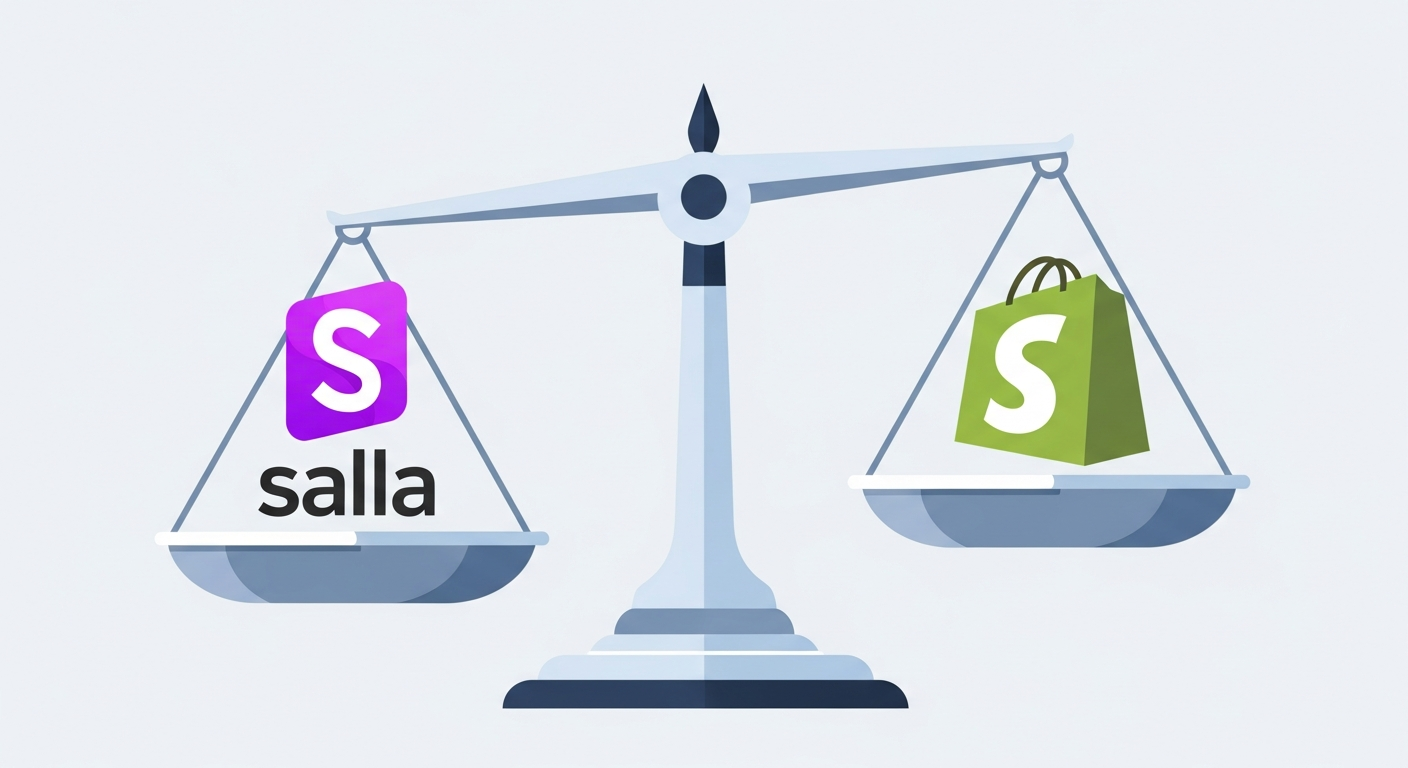




In the rapidly evolving world of e-commerce, choosing the right platform for your store is the first and most critical step towards success and sustainability. The Arab digital landscape, particularly in the Gulf region, is witnessing tremendous growth, driven by increased internet and smartphone usage and consumers' preference for online shopping. With this growth, numerous platforms compete to offer the best solutions for merchants, and three major players stand out: Salla, Zid, and Shopify. Each of these platforms boasts unique features and characteristics that might make it the optimal choice for a specific category of merchants, but this variety can cause significant confusion for new entrepreneurs or even existing stores looking to expand or migrate.
The decision to choose a platform is not merely a personal preference; it's a long-term investment that directly impacts operational costs, ease of management, expansion capabilities, customer experience, and ultimately, your profits. Are you looking for a simple, straightforward solution suitable for small local stores? Or do you need high flexibility and unlimited customization to enter global markets? Or perhaps you're seeking a platform that provides professional tools for rapid expansion in a specific market? These questions and more are what we will attempt to answer in this comprehensive article, to help you understand the fundamental differences between Salla, Zid, and Shopify, and to enable you to make an informed decision that aligns with your store's vision and future goals.
Understanding Your E-commerce Store's Needs First
Before diving into the specifics of each platform and its features, it is absolutely essential to take a step back and clearly and transparently assess your e-commerce store's needs. Choosing the optimal platform doesn't start with merely comparing technical features; it begins with a deep understanding of your business model, your short-term and long-term goals, and your available resources. This preliminary assessment will define the general framework within which you will operate, reducing the likelihood of selecting a platform that doesn't align with your aspirations, which could cost you time, effort, and money in the future. Your vision for what you want to achieve with your e-commerce store must be clear.
Identifying these core needs will help you filter the available options and focus your efforts on platforms that effectively meet your requirements. For instance, if you sell digital products, your needs will differ dramatically from a store selling physical products requiring inventory management and shipping. If you plan to sell in one specific market, your requirements will be different from a store aiming for global expansion. Therefore, this preliminary step is not just a formality; it is the cornerstone upon which all subsequent decisions are built to ensure the success of your e-commerce venture.
Investing the necessary time to define these aspects will bring significant benefits, as it ensures you won't fall into the trap of shiny features that may not be relevant to your store, or that you won't overlook essential requirements necessary for its growth. The clearer your vision, the more accurate and sound your decision will be, paving the way for a robust, sustainable e-commerce store capable of achieving its goals efficiently. Remember that building a solid foundation begins with a deep understanding of what you intend to build.
Defining Your Goals and Business Model
What do you aim to achieve with your e-commerce store? Is your goal to sell simple handmade products as an additional income? Or do you aspire to build a massive brand serving thousands of customers daily? The answer to these questions will form the basis of your choice. If you sell unique products in limited quantities, you might not need the complexities of a global platform like Shopify. However, if your business model relies on wholesale or subscriptions, you'll need specific features that may not be available on all platforms by default. Your goals must be clear and measurable, whether related to sales volume, customer count, or geographical expansion.
Your business model also plays a crucial role. Are you a retailer? Do you rely on dropshipping? Do you offer digital services or consultations? Each business model has specific requirements regarding product management, payment gateways, shipping options, and marketing. For example, a dropshipping store will need strong integrations with suppliers and order automation tools, while a store selling artisanal products might focus on easy visual product display and direct communication with customers. Writing captivating product descriptions is essential regardless of the platform, but the tools available for it differ.
Understanding these aspects helps you prioritize. Is customization flexibility paramount? Or ease of use for beginners? Or low cost? By clearly defining your goals and business model, you'll be able to evaluate each platform based on its ability to support these objectives, not just on the number of features it offers. This strategic approach will ensure a successful choice that serves your store long-term and avoids costly re-evaluations and changes in the future.
Budget and Available Time
The budget allocated for setting up and managing your e-commerce store is one of the most critical factors in platform selection. This isn't just about the monthly subscription cost of the platform; it also includes design costs, purchasing paid themes, subscriptions for apps and add-ons, marketing expenses, and even payment gateway fees. Some platforms like Shopify might have higher monthly costs but offer flexibility and apps that could save you custom development costs. Meanwhile, platforms like Salla and Zid might offer more affordable plans, especially for beginners, with an integrated package of essential features.
Time is another crucial factor. If you need to launch your store with maximum speed, platforms known for their ease of setup and use, like Salla and Zid, might be the best choice. These platforms are designed to be intuitive and minimize the learning curve, allowing you to launch your store in a matter of days rather than weeks or months. However, if you have ample time and aspire to a unique experience and deep customization, Shopify can provide the necessary tools, but it requires more time for learning and tailoring to your vision.
You must be realistic about your available resources. Do you have a specialized technical team capable of handling complex customizations? Or are you relying solely on yourself to manage the store? Does your budget allow for investing in essential paid apps for your business? Or are you looking for free solutions as much as possible? Estimating these aspects will help you avoid future frustrations and ensure that the platform you choose aligns with your financial and time capabilities. Remember, the goal is to build a successful and sustainable store, not just to pick the most popular or feature-rich platform.
Overview of Platforms: Salla, Zid, and Shopify
After identifying your store's needs, goals, and budget, it's time to get acquainted with the three main platforms we'll discuss in this article: Salla, Zid, and Shopify. Each of these platforms has unique characteristics in its field and targets a specific segment of merchants. Understanding these fundamental differences will set you on the right path to making an informed decision. We will provide a brief overview of each platform, focusing on its strengths and target audience, to enable you to form an initial impression of its compatibility with your e-commerce store.
This overview is not just a listing of features; it's an attempt to understand the philosophy behind each platform and how it's designed to serve specific types of businesses. For example, you'll find that some platforms prioritize simplicity and ease to meet the needs of emerging stores, while others focus on flexibility and scalability to meet the requirements of large, globally ambitious companies. This divergence in focus makes the choice difficult but at the same time ensures a variety of solutions for every type of e-commerce business in the Arab market.
The goal of these sections is to provide you with enough information to grasp the essence of each platform, which will facilitate the detailed comparison that will follow. Remember that no platform is "best" in an absolute sense; rather, there is a platform that is "most suitable" for your specific store and circumstances. Therefore, read these sections carefully and consider how each platform aligns with the vision you've set for your store in the preceding steps, to build a solid foundation for your final decision.
Salla: The Ideal Solution for Emerging Local Stores
Salla is one of the most prominent e-commerce platforms in the Arab region, gaining widespread popularity due to its focus on meeting the needs of local merchants, especially in Saudi Arabia. Salla features a user-friendly and intuitive interface, making it an excellent choice for beginners and small business owners who lack prior technical experience in building online stores. The platform provides a comprehensive set of essential tools any store needs to get started, such as product management, order processing, and providing easy-to-integrate local payment gateways.
One of Salla's main strengths is its strong support for the Arabic language and local currencies, and its seamless integration with popular local shipping companies, which allows merchants to focus on their operational processes without worrying about complex technical details. It also offers an app marketplace for add-ons that can be used to extend store functionalities, although design customization options are less flexible compared to other platforms. Choosing the right payment gateways is vital for local stores, and Salla offers strong integrations in this aspect.
Salla is ideal for stores targeting the local market that desire a comprehensive, quick-to-launch, and affordable solution. It provides a stable and reliable working environment, with Arabic technical support, reducing barriers for new merchants. If you are looking for a platform that enables you to start your e-commerce store as quickly as possible with minimal technical effort, focusing on the Saudi market, Salla will often be your first and most suitable choice, allowing you to concentrate on selling your products and serving your customers.
Zid: Expansion and Professionalism in the Saudi Market
Zid platform emerges as another strong option in the Saudi and Arab markets, positioning itself as an integrated platform for e-commerce stores seeking expansion and professionalism. Zid shares with Salla a focus on the local market and provides robust support for the Arabic language and local currencies, but it stands out by offering more advanced options for stores that have started to grow and require additional features to manage their operations and expand their reach. Zid provides advanced analytical tools, broader customization options, and deeper integrations with inventory management and accounting systems.
Zid also distinguishes itself by focusing on building a strong merchant community and providing continuous training and support programs, which help merchants develop their skills and increase their sales. Zid's user interface is professional and offers a feature-rich dashboard, which might require some time to get used to compared to Salla, but in return, it gives you greater control over various aspects of your store. This platform is suitable for medium to large stores with a clear vision for growth and a desire to leverage advanced analytical and marketing tools to increase efficiency.
If you started with a small store and have reached a stage where you need more powerful tools for expansion, or if you are launching an ambitious e-commerce project in the Saudi market that requires greater flexibility in management and customization, Zid offers the necessary solutions. It represents a bridge between Salla's simplicity and Shopify's flexibility, focusing on meeting the needs of the Saudi market while providing professional tools for growth, making it a strategic choice for stores looking to excel and expand in the region. Search engine optimization is an important aspect for increasing visibility, and Zid offers good tools for this purpose.
Shopify: Global Leadership with Unrivaled Flexibility
Shopify is the undisputed e-commerce giant globally, hosting millions of stores worldwide. What sets Shopify apart is its unparalleled flexibility and ability to adapt to any size or type of business, from small stores to large enterprises. The platform offers a very wide range of themes (free and paid) that allow extensive customization of the store's design, in addition to a massive app store (Shopify App Store) containing thousands of applications that add almost any functionality you can imagine, from advanced marketing tools to complex inventory management systems.
Shopify also features strong support for global selling, supporting multiple languages and currencies, and providing integrations with international and local payment gateways and shipping companies. Although its monthly subscription cost might seem slightly higher compared to Salla and Zid, the value it offers in terms of flexibility, global scalability, and worldwide support is invaluable for stores aiming for global reach. Shopify requires a relatively longer learning curve, especially if you want to utilize all its features and deeply customize your store, and it might require some technical expertise or reliance on developers.
If your vision for your store extends beyond local boundaries and aims to reach a global audience, or if you require unique customizations to differentiate your brand, Shopify is the ideal choice for you. It gives you the power and freedom to build your dream store, no matter its complexities, and provides the necessary infrastructure to handle any volume of traffic or sales. While the initial cost and complexity might be greater, the long-term return on investment for global and ambitious stores is immense. Shopify is not just a platform; it is a complete e-commerce ecosystem.
Detailed Comparison Between Salla, Zid, and Shopify
Now that we've had an overview of each platform, it's time to delve into a detailed comparison between Salla, Zid, and Shopify based on a set of critical criteria that directly impact your store's performance and success. This comparison will help you understand the fundamental differences between these platforms in practice and how each can or cannot meet your specific needs. We will focus on the most important aspects that every merchant should consider when making a crucial decision about their e-commerce platform, ensuring the selection of the optimal choice that supports their vision and goals.
The goal of this section is not only to highlight the strengths and weaknesses of each platform but also to provide a clear insight into the suitability of each for different types of stores. For instance, a platform might be user-friendly for beginners but lack the advanced customization options needed by larger stores, and vice versa. By analyzing these aspects in depth, you will be able to weigh the pros and cons of each platform and determine which one best aligns with your operational requirements, budget, and the target audience of your e-commerce store.
Remember that the best platform is the one that enables you to achieve your goals with the least hassle and the greatest effectiveness. Therefore, pay close attention to the details in this comparison and consider how each point might affect your daily operations and your long-term strategy. This comparison will serve as your comprehensive guide to deciphering the complexities of platform selection and will help you make a decision based on accurate and well-thought-out information, paving the way for a successful and thriving e-commerce store.
Ease of Use and Setup
Ease of use is one of the most critical factors for beginners and small businesses. In this regard, Salla and Zid significantly outperform Shopify, especially for users in the Arab region. Salla's interface is designed to be intuitive and straightforward, allowing you to create your store, add products, and activate payment gateways within a few hours, without requiring any coding experience. Zid also offers an easy experience, but it might take slightly longer to get accustomed to its feature-rich dashboard compared to Salla, yet it remains easy for the Arab user.
As for Shopify, while it offers a clean and organized user interface, the learning curve can be somewhat higher, especially if you want to utilize all customization options and integrations. Additionally, initial support for the Arabic language in Shopify might require some manual adjustments or the use of additional apps to ensure a fully integrated Arabic experience for customers, which comes ready and built-in with Salla and Zid. This makes Salla and Zid more attractive options for beginners looking for a quick launch with minimal technical effort in the local market.
In summary, if your top priority is ease of launch and operation with minimal technical complexity and in a short time, Salla and Zid lead the pack. They offer a tailored experience for the Arab market that reduces entry barriers. In contrast, if you are willing to invest some time in learning and have global ambitions or deep customization needs, Shopify provides the necessary tools, but with a slightly longer learning curve. You must balance your need for speed and simplicity against the desire for flexibility and customization in the long run.
Cost and Pricing Plans
The cost and pricing plans vary significantly among the three platforms, and this is a crucial factor for any merchant. Salla and Zid offer competitive pricing plans starting at low monthly fees, with multiple options to suit different store sizes. These plans typically include a large number of essential features without the need for many additional subscriptions, making them highly economical for emerging and small stores. Zid might be slightly higher in some of its plans compared to Salla, but it offers more advanced features in return.
Shopify, on the other hand, starts its pricing plans at a higher cost than Salla and Zid, and the cost can increase significantly when adding essential paid apps for your business or choosing premium themes. However, Shopify offers tremendous value for this cost in terms of flexibility, global scalability, and infrastructure power. Transaction fees, which some platforms might impose on each sale if you don't use their proprietary payment gateways, should also be considered, as this can affect your profit margin.
When evaluating cost, don't just look at the basic monthly price; consider the Total Cost of Ownership, which includes the cost of apps, themes, support, and any additional development costs you might need. If your budget is limited and you want to start with the lowest possible cost while getting an integrated package, Salla and Zid offer excellent solutions. However, if you are willing to invest more for greater flexibility and global scalability, Shopify is the option worth considering. Remember that increasing conversion can justify investing in a platform with higher features.
Customization and Design
The ability to customize your store's design and features is a critical factor in building a unique and appealing brand. In this aspect, Shopify stands unchallenged. Shopify offers thousands of professional themes (free and paid) that can be extensively customized to match your brand identity, in addition to a powerful design editor that allows deep interface modifications without requiring coding knowledge. Its rich app ecosystem also allows adding any functionality you might need, giving you unparalleled flexibility in building a unique store.
As for Salla, it provides a good selection of ready-made templates that can be customized to some extent in terms of colors, fonts, and the arrangement of certain elements, but deep design customization options might be limited compared to Shopify. Salla's goal is to provide a quick and straightforward solution, not endless customization. Zid, on the other hand, offers more design flexibility than Salla, sometimes providing advanced modification options, but it still doesn't reach the level of flexibility and variety offered by Shopify in terms of themes and third-party apps.
If building a unique visual identity and a fully customized user experience is your top priority, Shopify is the best choice. It gives you complete freedom to design a store that perfectly reflects your brand. However, if you are looking for a ready-made solution with a professional and acceptable appearance along with some basic customization options, Salla and Zid will suffice, with Zid slightly outperforming Salla in this aspect. You must balance your need for absolute customization against your desire for a quick and cost-effective solution.
Features and Add-ons (Apps)
Built-in features and the platform's ability to expand through apps and add-ons are among the most crucial aspects to evaluate. Shopify excels with its massive app store, which contains thousands of applications covering almost every aspect of e-commerce, from marketing and automation to inventory management and customer service. This gives merchants unlimited ability to customize their store's functions and add any feature they need, although many of them are paid.
Salla and Zid also offer app marketplaces, but they are smaller in size and variety compared to the Shopify App Store. Salla focuses on providing essential built-in features that most local merchants need and offers a number of apps that extend these functionalities. Zid, in turn, provides a wider range of built-in features and advanced apps that meet the needs of growing stores in the Saudi market, especially concerning analytics and integrations with third-party systems.
When comparing, you should ask yourself: Are the platform's built-in features sufficient for my current and future needs? And do the available apps (both free and paid) fill any gaps? If you need maximum flexibility and the ability to add any functionality you can imagine, Shopify is the ideal choice. However, if your needs are simpler or focused on a specific market and you prefer an integrated solution with minimal need for external apps, Salla and Zid offer strong solutions, with Zid excelling in providing more advanced features for growing stores.
Technical Support and Community
The quality of technical support and an active community around the platform can make a significant difference in your journey as an e-commerce merchant, especially when facing technical challenges. Salla and Zid excel in this aspect for Arabic users, as they provide technical support in Arabic, often available through multiple channels such as live chat, email, and phone. They also have active communities of merchants in the region, facilitating knowledge exchange and peer-to-peer assistance. This locally oriented support reduces language and cultural barriers.
Shopify, being a global platform, offers 24/7 technical support through multiple channels, but Arabic language support might be less available or limited compared to English. However, Shopify has a massive global community of developers and merchants, as well as an immense amount of educational resources and forums where solutions to almost any problem can be found. It might require some effort to search in English, but in return, it provides access to an unparalleled knowledge base.
If you value fast and direct technical support in Arabic and wish to join a local merchant community, Salla and Zid are the better choices. However, if you are comfortable dealing in English and capable of searching for solutions in global forums, Shopify offers you a very extensive global support network. You must balance the need for quick local support and ease of communication against access to a much broader global knowledge base, considering your comfort level with English.
Scalability and Growth
Scalability is one of the most important criteria to consider when choosing a platform for your store, especially if you have ambitions for future growth. In this aspect, Shopify is undeniably superior. It is designed to handle any volume of traffic and sales, from very small stores to giant enterprises. Its robust infrastructure and ability to host millions of products and receive hundreds of thousands of orders daily make it the ideal choice for stores planning to expand both locally and globally.
Salla and Zid, although they offer good expansion options for stores in the local market, their ability to handle massive expansion or entry into global markets might be limited compared to Shopify. Salla is suitable for small to medium-sized stores focusing on the Saudi market and can grow within this framework. Zid offers greater scalability than Salla and is suitable for medium to large stores professionally targeting the Saudi market, with advanced tools for managing growth.
If your vision for your store includes rapid expansion into multiple markets or handling huge sales volumes, investing in Shopify from the outset would be a wise decision. It will save you the hassle of migrating to another platform in the future. However, if your ambitions are limited to growth within the Saudi or regional market at the current stage, Salla and Zid can meet these needs excellently. You must consider your ambition for growth and identify the platform that can support this growth in the long term without costly changes.
Payment Gateways and Shipping Companies
The integration of payment gateways and shipping companies is the backbone of any e-commerce store and must be compatible with the target market. Salla and Zid excel in providing seamless and direct integrations with the most common local payment gateways in Saudi Arabia and the region, such as Mada, Visa, Mastercard, and local installment payment services, in addition to offering cash-on-delivery options. They also provide strong integrations with leading local shipping companies, facilitating shipping and delivery operations within the Kingdom and the region.
Shopify, for its part, supports a vast array of international payment gateways (such as Shopify Payments, PayPal, Stripe) and offers integrations with international and local shipping companies in many countries. Although it also supports some local payment gateways in the Arab region, its options might not be as smooth or comprehensive as the integrations Salla and Zid offer specifically with local services. However, its flexibility allows you to add custom payment gateways or use apps to connect specific shipping services.
For stores focused on the local market, Salla and Zid offer ready-made and ideal solutions in terms of payment gateway and shipping company integration. They reduce complexities and ensure a smooth payment and shipping experience for local customers. However, if you are targeting a global audience or need greater flexibility in choosing payment gateways and shipping companies across different countries, Shopify provides you with the ability to adapt to these global requirements. Your guide to choosing the best in Salla and Zid for payment gateways will help you in this aspect.
How to Choose the Most Suitable Platform for Your Store?
After this comprehensive comparison, you might be wondering: How do I translate all this information into a practical decision? The answer lies in revisiting your original needs and goals. There is no one-size-fits-all solution, and each platform has strengths and weaknesses that make it suitable for specific types of stores. To facilitate the selection process, we will provide recommendations based on common scenarios for e-commerce store owners, considering store size, target market, and available budget. Remember that the final decision should reflect your unique vision for your store.
Avoid falling into the trap of choosing a platform based on its popularity or what others choose. What suits a large store may not suit your small store, and what suits a global market may not suit a local one. Use the information provided in this article to evaluate each option based on your own criteria. Think long-term: Will the platform you choose today be able to support your growth in one or five years? Will it provide you with the necessary flexibility to adapt to market changes and customer needs?
The bottom line is that the best platform for you is one that balances ease of use, cost, features, scalability, and support, perfectly aligning with your goals. Do not hesitate to try platforms that offer free trial periods to get a firsthand feel for their interfaces and features before making a final decision. This practical approach will help you build confidence in your choice and ensure a strong and sustainable start in the thriving world of e-commerce. Now, let's look at the recommendations based on your store's size and ambition.
For Small and Emerging Local Stores
If you are just starting your e-commerce venture, or run a small store with limited products, and target the local market (especially the Saudi market), then Salla is the optimal choice for you. Salla offers an extremely easy experience for beginners, with a fully Arabic interface and ready-made integrations with local payment gateways and shipping companies. You won't need extensive technical expertise to launch your store within a few days. Its monthly costs are also very reasonable and suit the limited budgets of emerging projects. It allows you to focus on your products and customers instead of technical complexities.
In this scenario, the priority is speed of launch, ease of management, and low operating costs. Salla meets these needs excellently, reducing the barriers that a new entrepreneur might face. You can start with a basic plan and expand it later if your store grows. Arabic technical support and an active local community also represent an invaluable additional advantage for beginners who may need quick and targeted assistance in their early stages. It is a platform specifically designed to empower local merchants to enter the world of e-commerce with confidence.
Do not hesitate to utilize the free trial period offered by Salla to explore its interface and features. You will find that it provides everything you need to start a professional and effective store without the need for huge investments or prior technical expertise. It is the ideal choice for those looking for a comprehensive and locally-oriented solution to start their small store and achieve quick sales in the Saudi market.
For Medium-Sized Stores Targeting the Saudi Market
If your store has moved beyond the initial phase, has good sales volume, and you aspire to expand professionally within the Saudi market, or if you are starting an e-commerce project with more advanced requirements, then Zid is the most suitable choice for you. Zid offers more advanced features than Salla, such as better analytical tools, broader customization options, and deeper integrations with inventory management and accounting systems, giving you greater control over your store's operations. It is designed for stores that need powerful tools to support their growth and scale their operations.
Zid also provides a professional working environment with strong Arabic language support and excellent local integrations, but it further offers a feature-rich dashboard that helps you optimize your store's performance. It might take some time to get used to its interface, but the return on this learning investment is significant in terms of the ability to manage larger and more complex operations. It is the ideal choice for stores looking for a balance between ease of use and the power of advanced features for expansion in the local market.
Consider Zid as your next step after Salla, or as a strong start if you have a clear vision for a medium to large store in the Saudi market. It will enable you to achieve your expansion goals and provide a professional shopping experience for your customers, while benefiting from a working environment specifically designed for the region. It gives you the tools you need to elevate your store to the next level of success and professionalism.
For Large and Globally Ambitious Stores
If your vision for your store extends beyond local boundaries and you aspire to reach a global audience, or if you manage a large brand that requires unlimited flexibility and deep customization, then Shopify is the undisputed optimal choice. Shopify provides a powerful global infrastructure capable of handling any volume of sales and traffic, in addition to a massive app store that allows you to add any functionality you might need and fully customize your store to fit your unique identity.
Shopify gives you complete freedom to expand globally, with support for multiple languages and currencies, and integrations with international payment gateways and shipping companies. Although its monthly cost may be higher and it may require a longer learning curve, the value it offers in terms of scalability, flexibility, and global support is invaluable for stores aiming for global reach. You will need to invest time and money in learning and customizing the platform, but the return on this investment is immense in the long run.
Choose Shopify if you are ready for the challenge and want to build a world-class store, or if you have a technical team that can handle complex customizations. It is not just a platform; it is a complete ecosystem that puts all the necessary tools in your hands to achieve your global ambitions. It will enable you to build a strong and competitive brand in any market around the world, while providing the necessary infrastructure to handle massive growth. Increasing conversion is key to global success, and Shopify provides the tools for it.
In conclusion, choosing the right e-commerce platform is a strategic decision that lays the foundation for your store's long-term success. In this article, we have reviewed Salla, Zid, and Shopify, and provided a detailed comparison of their various aspects, from ease of use and cost to customization and scalability. Remember that there is no single "best" platform; rather, there is a platform that is "most suitable" for your specific store, its circumstances, and its unique needs. The key lies in a deep understanding of your goals, budget, and target audience.
If you are starting a small store targeting the Saudi market and prefer simplicity and speed of launch, then Salla is your first choice. If you are managing a medium-sized store and aspire to expand professionally in the Saudi market with a need for more advanced tools, then Zid offers you the ideal solutions. And if your ambitions are global, requiring unlimited flexibility, deep customization, and massive scalability, then Shopify is the platform that will enable you to achieve your vision without limitations. Each of these platforms has the ability to empower you to build a successful e-commerce business, provided it matches your requirements.
Therefore, take your time to think, evaluate the options carefully, and do not hesitate to take advantage of the platforms' trial periods to experience them firsthand before making a final decision. Your decision today will determine the trajectory of your store tomorrow. Choose wisely, and build a thriving e-commerce store that meets your aspirations and serves your customers' needs effectively and efficiently. We wish you all the best in your journey in the world of e-commerce, as the Arab market awaits your initiatives and creativity.