




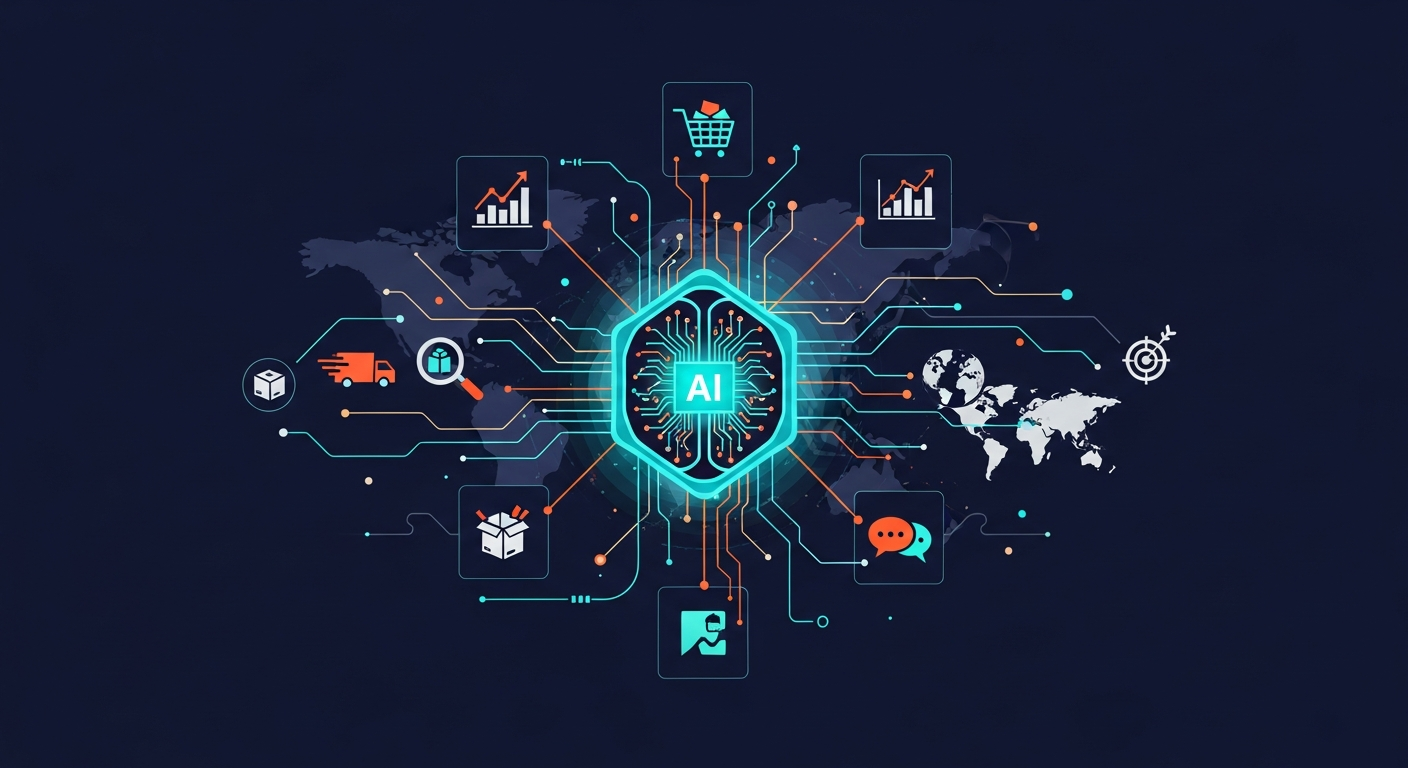
Introduction: The Age of AI in E-commerce
The world is undergoing an unprecedented digital transformation, and Artificial Intelligence (AI) is the driving force behind this shift, especially in the rapidly growing e-commerce sector. AI is no longer just a futuristic technology; it has become an essential tool for online store owners looking to enhance their competitiveness and maximize every sales opportunity. Integrating AI solutions into e-commerce platforms like Salla, Zid, and Shopify can unlock new avenues for innovation and efficiency, directly contributing to an improved customer experience and significantly boosting profits.
In the face of intense competition in the digital marketplace, differentiation has become imperative. Stores that embrace modern technologies, particularly AI, are the ones that will stay ahead, attract more customers, and retain them. AI offers immense capabilities for understanding consumer behavior, personalizing shopping experiences, and automating operations, allowing store owners to focus on the strategic aspects of their business growth. This article will delve into how AI can be leveraged to enhance your store on Salla and Zid, and how it can revolutionize the way you manage your commercial project, also mentioning practical examples for Shopify due to its flexibility in integrating with advanced technologies.
The goal of this comprehensive guide is to equip e-commerce store owners with the knowledge and tools necessary to successfully adopt AI. We will explore how AI can turn challenges into opportunities by optimizing marketing processes, personalizing user experience, and efficiently analyzing big data at an unprecedented scale. Whether you manage a small store on Salla or Zid, or a larger venture on Shopify, understanding the applications of AI will give you an invaluable competitive edge in an ever-changing market. Let's embark on a journey to discover how this revolutionary technology can empower your online store and propel it towards new horizons of success and prosperity.
AI for Enhancing Customer Experience on Salla, Zid, and Shopify
Customer experience is the cornerstone of any successful online store, and AI offers innovative solutions to transform this experience from a mere transaction into an unforgettable interactive and personalized journey. By gaining a deeper understanding of customer needs and preferences, AI can create a tailored shopping environment for each visitor, increasing conversion rates and fostering brand loyalty. This enhancement is not limited to the storefront; it extends to every touchpoint between the customer and the store, from the moment they search for products to the post-purchase phase, ensuring long-term customer satisfaction and encouraging repeat business.
On platforms like Salla and Zid, integrated or third-party AI tools can provide highly accurate product recommendations based on the customer's purchase and browsing history, and even products viewed by other customers with similar interests. This approach reduces the time customers spend searching for suitable products and increases the likelihood of them discovering new items that might pique their interest, thereby boosting the average cart value. The ability to predict products a customer might need before they even search for them is a powerful competitive advantage that enhances the store's appeal and uniqueness in the market.
As for Shopify, the abundance of AI-powered applications and plugins provides store owners with broader options to personalize customer experiences like never before. Whether these applications offer advanced recommendations or real-time customer behavior analysis, the goal remains the same: to make the shopping experience easier, more enjoyable, and more effective. Investing in these technologies is not just a luxury; it has become an urgent necessity to keep pace with the increasing customer expectations in an era of speed and personalization, directly contributing to building strong and lasting relationships with them.
Personalized Product Recommendations
Personalized product recommendations are one of the most powerful applications of AI in e-commerce. Instead of displaying a generic selection of products, AI can analyze customer data (such as browsing history, past purchases, favorite products, and even the behavior of similar users) to provide customized suggestions that perfectly match their interests. These recommendations are not limited to products the customer might buy but can also include complementary or alternative products that might interest them, increasing cross-selling and up-selling opportunities and enhancing the final shopping cart value.
On Salla and Zid platforms, store owners can leverage this feature by integrating specialized third-party smart recommendation applications or through built-in tools provided by the platforms for customer data analysis. For example, a store can show a customer who bought a smartphone, a phone case or earphones that are compatible with it, based on AI analyses of thousands of other customers' behaviors. This approach not only makes the shopping experience more efficient for the customer but also directly and indirectly increases the store's revenue by improving satisfaction levels and increasing return visit rates.
In Shopify, the app store contains a large number of AI-powered add-ons that offer hyper-personalized product recommendations. These applications use machine learning algorithms to analyze vast amounts of data and provide real-time recommendations on product pages, in the shopping cart, or even in marketing emails. Such recommendations can be a crucial factor in Conversion Optimization: Doubling Your Profits on Salla and Zid and Shopify, as customers feel that the store understands them and offers exactly what they are looking for, which enhances their trust and loyalty.
Chatbots and Technical Support
AI-powered chatbots are a revolutionary tool for improving customer service and providing instant technical support 24/7. Instead of relying entirely on a human support team, a chatbot can answer common questions, provide information about products, help customers track their orders, and even guide them through the purchasing process. This not only reduces the workload on the support team but also ensures quick and effective responses to customer inquiries, enhancing their satisfaction and overall experience.
On Salla and Zid platforms, store owners can integrate chatbots through specialized third-party applications that offer user-friendly interfaces and seamless integration. These robots can learn answers from a FAQ database and develop their ability to understand customer inquiries over time, thanks to natural language processing (NLP) technologies. For example, a customer can ask: "Where is my order?", and the bot will search for the order number and provide the shipping status within seconds, offering a quick and convenient experience without waiting.
Shopify also offers a wide range of chatbot applications that integrate easily with the store, providing advanced capabilities such as collecting customer data, guiding them to appropriate products, and even completing simple sales transactions. These chatbots are not limited to providing passive support; they can also be effective marketing tools by offering special promotions or informing customers about new products. Investing in this technology means your store is always available to its customers, making a significant difference in service levels and overall satisfaction, and contributing to building a strong relationship between the customer and the store.
Smart Search Engines and Filtering
Product search within an online store is a critical step in the customer's journey, and traditional search engines may not always be sufficient to meet user expectations. This is where AI comes in to enhance search and filtering capabilities, making product discovery more accurate, easier, and more efficient. Instead of merely matching keywords, smart search can understand user intent, automatically correct spelling errors, and suggest related products even if they are not explicitly mentioned in the query.
On Salla and Zid, store owners can improve the search experience by using specialized third-party smart search applications that can analyze customers' past search behavior and provide more relevant results. For example, if a customer searches for "blue dress," the smart search engine can display blue dresses in different shades, or even other similar styles of dresses, even if not entirely blue, based on what other customers who searched for the same keyword preferred. This personalization increases the likelihood of the customer finding exactly what they want and reduces bounce rates.
Shopify also offers a wide range of applications that enhance search and filtering functionalities, using AI to improve ranking results and display products most relevant to the customer. These tools not only make search faster but also smarter, as they can understand the context behind complex search queries. Investing in smart search engines and filtering directly contributes to Conversion Optimization: Doubling Your Profits on Salla and Zid and Shopify, by simplifying the product discovery journey and making it more enjoyable and productive for the customer, ultimately leading to increased sales and customer loyalty.
AI for Enhancing Operational Efficiency and Marketing
AI's role is not limited to improving customer experience; it also extends to boosting operational efficiency and automating many routine tasks that consume significant time and effort from store owners. By analyzing big data, AI can provide valuable insights that help in making informed decisions about inventory, pricing, and marketing, leading to reduced costs and increased profitability. This ability to automate and optimize processes enables store owners to focus on growth and expansion, rather than getting bogged down in daily details that AI can handle with greater efficiency.
On platforms like Salla and Zid, AI can revolutionize inventory management and determine optimal reorder times, based on historical sales patterns and future demand forecasting. It can also help identify best-selling and slow-moving products, allowing store owners to optimize their product assortment and avoid unwanted stock accumulation. These capabilities ensure that the store is always ready to meet customer demands, reduces the risk of stockouts, and contributes to enhancing the store's reputation and overall customer satisfaction, while minimizing opportunities for customer loss due to product unavailability.
As for Shopify, integration with AI tools dedicated to operations management and marketing opens the door to unprecedented levels of automation and optimization. Whether it involves managing advertising campaigns, personalizing email marketing messages, or even optimizing product content for search engines, AI provides the necessary tools to achieve maximum efficiency and effectiveness. Stores can make significant leaps in their operational and marketing performance, contributing to sustainable growth and increased revenue, and strengthening their ability to compete in the evolving digital market.
Data Analysis and Demand Forecasting
Big Data analysis and demand forecasting are among the most crucial applications of AI for e-commerce store owners. By processing and analyzing vast amounts of data, such as sales records, browsing patterns, customer demographics, and even external factors like seasons and holidays, AI can accurately predict which products will be in demand in the future. This predictive capability enables store owners to make informed decisions about inventory management, planning promotional offers, and identifying new products to focus on, thereby reducing waste and increasing efficiency.
On Salla and Zid, store owners can utilize built-in data analysis tools or integrate with external AI-powered analytical tools. These tools do not just display historical data but provide actionable insights into customer behavior and market trends. For example, an AI system can predict an increase in demand for certain products months before the holiday seasons, allowing the store to secure sufficient inventory and plan early marketing campaigns. This proactive approach contributes to increased sales and avoids stockouts during peak times, enhancing the store's ability to effectively meet customer demands.
Shopify also offers a wide range of applications that provide advanced analytics and accurate demand forecasts, helping to optimize supply chains and manage inventory efficiently. These tools use machine learning algorithms to identify hidden patterns in data, and provide recommendations on the best times to reorder, and the optimal quantities of each product. Understanding our article on Salla vs Shopify: Which is Best for Your Store? will help you choose the platform that provides the best data analysis tools, enabling you to make data-driven decisions, and boosting your store's profitability and ability to sustain growth in the market.
Dynamic Product Pricing and Inventory Optimization
Dynamic pricing and inventory optimization are areas where AI can make a tremendous difference. Instead of fixed pricing, AI can adjust product prices in real-time based on multiple factors such as current demand, competitor prices, inventory levels, and even user behavior. This approach ensures your prices are always competitive, allows you to maximize profits while maintaining the store's appeal to customers, and contributes to reducing risks associated with stock accumulation or stockouts.
On Salla and Zid, store owners can leverage AI applications that monitor competitor prices and recommend price adjustments automatically. For example, if a competitor lowers the price of a specific product, the system can suggest lowering your price slightly to maintain competitiveness, or offering a promotion instead. This eliminates the need for constant manual intervention, saving valuable time for store owners. AI can also help identify products that need to be cleared or discounted before they become obsolete or undesirable, thereby minimizing losses.
Shopify also offers advanced solutions for dynamic pricing and inventory optimization through its app marketplace. These tools use complex algorithms to analyze historical and current data, predict demand, and determine the best pricing strategies for each product at different times. You can refer to our article on Product Pricing: Smart Strategies for Salla and Zid Stores for a deeper understanding of how these strategies work and how AI can enhance them. Integrating AI into these processes ensures your store operates at maximum efficiency, maximizes revenue from each product, and effectively reduces operational risks.
Personalized Marketing and Targeted Advertising
Personalized marketing and targeted advertising are among the most important applications of AI in boosting sales and improving the effectiveness of marketing campaigns. Instead of sending generic marketing messages to all customers, AI can analyze each customer's data individually, identify their interests and preferences, and then craft personalized marketing messages and promotional offers for them. This approach significantly increases email open rates, ad click-through rates, and ultimately, conversion rates.
On Salla and Zid, store owners can leverage AI tools to create personalized email campaigns and target customers with social media ads based on their past behavior within the store. For example, if a customer visited a specific product page multiple times without purchasing, AI can send them a reminder email with a special offer on that product, or display a targeted ad on Facebook or Instagram. This personalization makes marketing messages more relevant to the customer and increases the likelihood of their response.
Shopify also offers a wide range of AI applications that enable store owners to manage hyper-personalized marketing campaigns and optimize ad targeting across various platforms. These tools use machine learning algorithms to analyze the performance of marketing campaigns in real-time and adjust them to achieve the best results. You can read Email Marketing: Boosting Sales in Salla and Zid to learn more about how to integrate AI into your marketing strategies. Investing in personalized marketing and targeted advertising directly contributes to maximizing the return on investment of your marketing campaigns and effectively and sustainably boosts the growth of your online store.
Challenges and Considerations for Implementing AI in Online Stores
Despite the numerous advantages AI offers to online stores, there are also challenges and considerations that store owners must take into account when contemplating integrating these technologies. Understanding and preparing for these challenges in advance is crucial to ensure the success of the integration process and to maximize the benefits from your AI investments. Among the most significant challenges are dealing with vast amounts of data, ensuring its quality and accuracy, in addition to ethical and legal aspects related to customer data privacy, which require special attention and careful planning.
Another challenge is the initial cost of adopting AI solutions, whether in the form of monthly subscriptions for third-party applications or custom development costs. These costs might seem high initially, especially for small or nascent stores on platforms like Salla and Zid. However, AI should be viewed as a long-term investment that can yield significant returns by increasing efficiency, improving customer experience, and boosting sales. Good financial planning and choosing solutions appropriate for your budget and needs are key to success in this regard, considering that there are diverse solutions suitable for various store sizes.
Finally, building customer trust is paramount when using AI. While customers appreciate personalization and convenience, they are also concerned about the privacy of their data and how it is used. Store owners must be transparent about how customer data is collected and used, and adhere to best practices and ethical standards to protect this data. Balancing the utilization of AI's power with maintaining customer trust is a major challenge, but it is essential for the long-term success of your store on Salla, Zid, and Shopify, requiring continuous effort in clear and honest communication with customers.
Data Privacy and Ethical Use
Data privacy and the ethical use of AI are among the most critical challenges and considerations facing e-commerce store owners. While AI heavily relies on collecting and analyzing customer data to provide personalized experiences, protecting this data and respecting its privacy is of paramount importance. Store owners must adhere to local and international regulations and laws related to data protection, such as the General Data Protection Regulation (GDPR) in Europe, and other data protection laws worldwide, to ensure compliance and avoid legal penalties.
On Salla, Zid, and Shopify, store owners must ensure that any AI tools integrated comply with strict privacy standards. This includes obtaining explicit consent from customers before collecting their data, clarifying how this data will be used, and providing customers with options to control their personal information. Transparency in handling customer data is not just a legal obligation; it is also a fundamental factor in building trust and brand loyalty, as customers feel secure when shopping from a store that respects their privacy and diligently protects their personal information.
Store owners must also be aware of the ethical implications of using AI, such as avoiding bias in recommendations or pricing based on unfair factors. Using AI in a responsible and ethical manner not only enhances the store's reputation but also ensures that technology is used to serve customers positively and fairly. These considerations are fundamental for the long-term success of any e-commerce store seeking to integrate AI into its operations and require continuous review of policies and procedures to ensure compliance with the latest ethical and legal standards in this constantly evolving field.
Cost and Technical Integration
Initial cost and technical integration are major challenges for store owners when considering integrating AI solutions. While some platforms like Shopify offer a rich marketplace of easily integrated applications, other platforms like Salla and Zid may require more effort in finding suitable third-party solutions or may have limited integration options. Store owners must conduct thorough research to estimate costs associated with monthly subscriptions, installation fees, or even the need for custom development, which can vary significantly depending on the store's size and technical requirements.
On Salla and Zid, store owners might find themselves needing to hire developers or technical experts to integrate some complex AI solutions, especially those requiring an API (Application Programming Interface) or deep customization. These additional costs must be included in the AI budget. However, there are many user-friendly tools that do not require significant technical expertise and offer seamless integration with these platforms, making them an attractive option for small and medium-sized stores looking to start their AI journey without massive initial investments.
As for Shopify, the ease of integration with applications through its extensive app marketplace significantly reduces the burden of technical costs, as many applications offer free trials or affordable plans. But even with this ease, store owners must evaluate the compatibility of these applications with the store's existing infrastructure and their impact on website speed and performance. Choosing solutions that do not hinder the user experience but enhance it is crucial to ensure that AI investment achieves its desired goals and delivers real value to both the store and its customers, helping to avoid future technical problems that could cost the store a lot of time and money.
Building Customer Trust
Building customer trust is a cornerstone for the success of any online store, and when integrating AI, this aspect becomes even more critical. While customers appreciate the personalization and convenience offered by AI technologies, they may be concerned about how their data is collected and used, or they may find interactions with chatbots impersonal. Therefore, store owners must be transparent and frank about the use of AI, and strive to maintain a human touch in customer interactions to foster trust and loyalty.
On Salla, Zid, and Shopify, store owners can build trust by clearly stating privacy policies and terms of use, and by indicating the use of AI in specific aspects such as recommendations or technical support. For example, a store using a chatbot can begin the conversation with a statement clarifying it is a bot, while providing an option to transfer to a human agent when needed. This straightforward approach reassures customers and shows that the store values their privacy and strives to provide the best possible service, whether automated or human.
Store owners can also enhance trust by using AI to tangibly improve the customer experience, such as providing quick and effective solutions to their problems, or customizing offers to suit their real needs. When customers see the direct benefits of using AI, they become more accepting of it and more confident in the store. Focusing on excellent customer service, whether AI-powered or human-intervened, is key to building long-term relationships with customers in the evolving e-commerce world, and enhances the store's reputation and competitive ability in the market.
Conclusion: The Future of E-commerce with an AI Touch
Artificial intelligence has become an undeniable force in the world of e-commerce, not merely a fleeting technological trend, but a fundamental driver of growth and innovation. From enhancing customer experience through personalized recommendations and chatbots to boosting operational efficiency through data analysis and dynamic pricing, AI offers store owners on Salla, Zid, and Shopify powerful tools to achieve a sustainable competitive advantage. Embracing these technologies is not an option but a necessity for stores seeking to stay ahead in an ever-evolving and competitive market, where customer expectations constantly change and demand innovative solutions that meet these renewed needs effectively and efficiently.
Despite the challenges related to privacy, cost, and technical integration, the long-term benefits of AI far outweigh these obstacles. Stores that invest in these technologies wisely and with planning, and place customers at the core of their strategies, are the ones that will reap the rewards of this digital transformation. Store owners must stay informed about the latest developments in AI and be prepared to experiment with new solutions and adapt them to their unique business needs. This flexible and innovative approach is what will enable them to maximize the immense potential AI offers to boost the growth and profitability of their online stores in the near and distant future alike.
In conclusion, it can be said that the future of e-commerce lies in intelligently and responsibly integrating AI. By focusing on building exceptional customer experiences, optimizing operational processes, and making data-driven decisions, store owners on Salla, Zid, and Shopify can revolutionize their businesses. AI is not just a tool; it is a strategic partner that can change the game, offer unlimited opportunities for growth and innovation, and enable your store to achieve its ambitious goals in a rapidly changing digital world. Start today to explore how AI can enhance your store and help you achieve market superiority.