




Keywords: Dominating Salla and Zid Search
In the rapidly evolving world of e-commerce, merely having an online store is no longer sufficient to achieve success and distinction. With the increasing number of stores launching daily on platforms like Salla, Zid, and Shopify, the real challenge lies in how to reach potential customers amidst this fierce competition. This is where keywords emerge as the cornerstone upon which strategies for appearing in search results are built, whether in general search engines like Google or within the platforms' internal search engines themselves.
Understanding how customers think and precisely what they are searching for, then translating this understanding into effective keywords, is what makes the difference between a store that remains in the shadows and one that dominates the scene, attracting thousands of visitors daily. Keywords are not just terms added randomly; they are a compass that guides customers to your products and services, and at the same time, a powerful tool that enables you to build bridges of trust and reliability with your target audience. Through this comprehensive article, we will delve deep into the world of keywords and how store owners on Salla, Zid, and Shopify platforms can intelligently leverage them to rank high in search results and maximize their marketing efforts.
What Are Keywords and Why Are They the Cornerstone of E-commerce?
Keywords are the phrases or words that users employ when searching for specific products or services through search engines. These keywords can be short and direct, such as “dress” or “perfume,” or long and specific, like “long red evening dress size large” or “long-lasting strong men's perfume.” The importance of keywords lies in their role as the meeting point between what a customer is looking for and what you offer in your online store, forming the foundation upon which all search engine optimization (SEO) efforts are built.
In the context of e-commerce, keywords play a pivotal role in determining the visibility of your products and store categories in search results. Without them, search engines will lose the ability to understand your page content and present it to the appropriate users. The strategic use of keywords in product titles, descriptions, category pages, and even blog posts directly contributes to increasing organic traffic to your store. This traffic is high-quality because it comes from people who are actively searching for what you offer, thereby increasing conversion rates and sales.
The impact of keywords is not limited to external search engines like Google; it extends to the internal search engines of e-commerce platforms such as Salla, Zid, and Shopify. When a customer searches within your store or within the list of stores on these platforms, the keywords you use in your product descriptions and categories determine whether your products will appear to them. Therefore, mastering the selection and application of keywords is a true investment that yields long-term profits and ensures your store's competitiveness and sustainability in the crowded e-commerce market.
Keyword Research: A Comprehensive Guide for Your Salla, Zid, and Shopify Store
Keyword research is the first and most crucial step in building a successful SEO strategy for your online store. Without a precise understanding of what your customers are searching for, your efforts will be akin to wandering in the dark. This research should be an ongoing and evolving process, influenced by market changes and consumer behavior. Whether you are using Salla, Zid, or Shopify, the fundamental principles of keyword research remain the same, with minor differences in how they are applied to each platform.
This process requires a combination of tools and strategic analysis to understand not only the words being searched but also the underlying intent behind those words. Is the customer looking for information, comparing products, or ready to make a purchase? Answering these questions will enable you to target the most effective keywords for your store. Below, we will outline the essential steps and advanced techniques for keyword research that will help your store dominate search results.
Remember that the goal is not just to find the most popular keywords, but to find keywords that align with your products and target audience, and that have a good chance of converting visitors into buyers. This requires patience and careful analysis, but the return on this investment of time and effort is well worth it, as you will have a strong list of keywords that will guide all your marketing content and SEO efforts.
Understanding Your Target Audience and Search Intent
Before embarking on keyword research, you must deeply understand your target audience. Who are your ideal customers? What are their interests, problems, and needs? And what language do they use to express these matters? Building buyer personas will help you visualize your customers better and anticipate the words they might use. For instance, if your store sells luxury products, your customers might use keywords like 'luxury Swiss watches' instead of 'cheap watches.'
Another crucial aspect is understanding search intent. Search intents can be categorized into four main types: informational (e.g., 'how to care for genuine leather?'), navigational (e.g., 'official XYZ store'), commercial investigation (e.g., 'Samsung vs. iPhone comparison'), and transactional (e.g., 'buy iPhone 15'). Targeting keywords based on the correct search intent ensures you attract visitors at the appropriate stage of the buying journey, increasing the likelihood of conversion. Long-tail keywords often express a more specific search intent and thus have higher conversion opportunities.
Furthermore, identifying short-tail keywords (e.g., 'clothes') and long-tail keywords (e.g., 'plus-size women's winter clothing') is vital. Short-tail keywords attract a large search volume but are highly competitive and sometimes have unclear intent. In contrast, long-tail keywords attract less volume but are more specific in intent and less competitive, making them ideal for targeting ready-to-buy customers. Combining both types in your strategy provides broader coverage and targets different stages of the customer journey.
Keyword Research Tools
Fortunately, there are many tools that can assist you in this task, some free and some paid. Among the most prominent free tools is Google Keyword Planner, which provides data on search volume and competition for various keywords. It can be used to discover new keywords and evaluate existing ones.
For paid tools, Ahrefs and SEMrush are among the most powerful on the market, offering deep competitor analysis, keyword suggestions, rank tracking, and comprehensive site analysis. These tools are indispensable for stores aiming for significant outperformance. Additionally, don't forget to use Google's Autocomplete feature and the internal search boxes within Salla, Zid, and Shopify, as they reveal common words and phrases customers actually use.
Don't stop at these tools; also analyze your competitors. What keywords are they ranking for? How do they use keywords in their product descriptions? This analysis can uncover untapped opportunities or keywords you hadn't considered. Reviewing customer comments and frequently asked questions can also be a rich source of keywords that reflect real problems and needs. You can refer to our comparison guide between Salla, Zid, and Shopify to choose the most suitable platform for your store, which might impact your specific keyword strategy.
Analyzing Common and Product-Specific Keywords
Once you have a list of potential keywords, you need to analyze them to filter out the most suitable ones for your store. Start with general keywords that describe the product categories you sell, such as 'women's clothing' or 'kitchen tools'. These keywords attract a large search volume but are also highly competitive. Then move on to more specific keywords related to particular products, such as 'long black evening dress' or 'electric blender for juices'. These keywords have a clearer purchase intent.
You should also consider geographical keywords if your store targets a specific region. For example, 'Riyadh perfumes' or 'Jeddah gifts'. These keywords help attract local customers who are looking for products or services near them. Analyzing seasonal keywords or those related to special occasions such as 'Mother's Day gifts' or 'White Friday sales' can also significantly boost your sales during peak periods.
Don't forget keywords related to problems or solutions that your products offer. For instance, if you sell skincare products, customers might search for 'acne treatment' or 'skin brightening products'. Targeting these keywords can bring you customers looking for specific solutions to their problems, making them more likely to purchase. Remember that the goal is to build a diverse list of keywords that cover various aspects of your store and products and cater to diverse needs and search patterns.
Implementing Keywords: Optimizing Your Store on Salla, Zid, and Shopify Platforms
Once you have a strong list of keywords, the most crucial step is to effectively implement them within your online store. Merely having keywords on a list is not enough; they must be strategically and naturally integrated into all parts of the store to ensure maximum visibility. Platforms like Salla, Zid, and Shopify offer various tools and options for keyword implementation, but the art lies in using these tools intelligently to serve your marketing objectives.
Remember that the goal is to optimize for both user experience and search engines simultaneously. Do not overuse keywords in a way that appears unnatural or annoying to users, as this could lead to adverse results. Instead, focus on creating valuable content that is rich in relevant keywords and answers customer questions, providing them with useful information. This approach ensures you build a strong and reliable store in the eyes of both search engines and customers.
In this section, we will review the main areas where you should integrate keywords, focusing on best practices to achieve maximum impact. From product titles to blogs, every part of your store represents an opportunity to enhance your visibility in search results and attract more potential customers. Invest time in optimizing all these aspects, and you will see your store's performance significantly improve.
Optimizing Product Titles and Descriptions
Product titles and descriptions are among the most critical places to integrate keywords. A product title should be descriptive, engaging, and contain the main keyword for the product. For example, instead of 'dress,' use 'Women's Long Satin Blue Evening Dress.' This title not only clarifies the product but also targets specific keywords such as 'evening dress,' 'women's long,' and 'blue satin.' Ensure that the most important keyword appears at the beginning of the title if possible.
As for product descriptions, they are your golden opportunity to provide detailed, keyword-rich information. Write unique and appealing descriptions that highlight the product's features and benefits, naturally integrating relevant keywords into the text. Use long-tail keywords that express a specific purchase intent. Don't just mention the product name; talk about materials, sizes, colors, uses, and unique features that make it stand out. The richer the description is with information and keywords, the higher the chance of your product appearing in specialized searches.
On platforms like Salla, Zid, and Shopify, you can add custom fields or use available formatting to highlight important keywords, such as using bold text or bulleted lists (
- ) to improve readability and user experience. Remember, the goal is to satisfy both search engines and customers; the content must be useful and clear for the reader, and keyword-rich for search engines. Avoid excessive keyword repetition (Keyword Stuffing) as it can harm your store's ranking.
Optimizing Category and Collection Pages
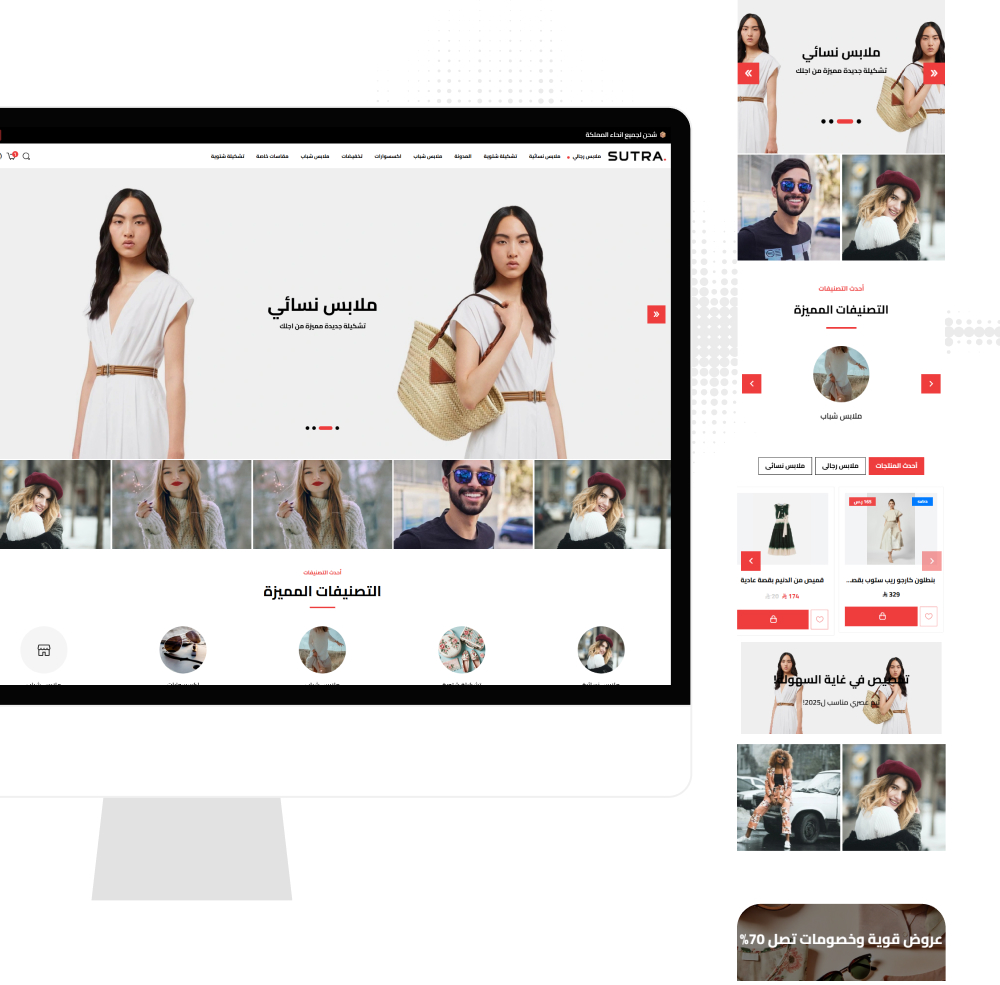
Category and collection pages are no less important than individual product pages. These pages serve as gateways to a large number of similar products and are excellent opportunities to target both broad and long-tail keywords. Ensure that your category and collection titles are clear and contain primary keywords. For instance, instead of 'dresses,' use 'Women's Evening Dresses' or 'Wedding Dresses.'
Each category or collection page should feature a unique, keyword-rich textual description at the top or bottom of the page. This description should provide an overview of the products within the category, their benefits, and how customers can benefit from them. Use keywords relevant to the main category and long-tail keywords that customers might use to search for sub-groups within that category. For example, in an 'Electronics' category, you might describe 'the latest smartphones at competitive prices.'
You can also use internal links between category pages and product pages to enhance keyword authority and facilitate browsing for both search engines and customers. Ensure that the link structure is logical and clear. The better optimized your category pages are, the higher their chances of appearing in general search results, attracting more visitors looking for broad ranges of products. Using keywords naturally in these descriptions not only boosts SEO but also helps customers quickly understand the category's content.
Using Keywords in Blogs and Content
Blogs and store content are excellent opportunities to target informational and long-tail keywords, building your store's authority in its niche. You can write articles on how to use your products, tips related to your industry, or product comparisons. For example, if you sell coffee tools, you could write an article titled 'Best Ways to Brew Specialty Coffee at Home,' targeting keywords like 'coffee brewing methods' and 'homemade specialty coffee.'
Integrating keywords into article titles, subheadings, and naturally within the body text will increase the chances of your articles appearing in search results when users look for information. This not only attracts visitors but also builds trust and credibility for your store as an expert in its field. Remember that the goal is to provide real value to the audience, not just stuff keywords. The higher the quality and usefulness of the content, the greater the chance of it being shared and acquiring backlinks, which generally boosts your store's ranking.
Utilize your blog to create keyword-rich content that targets different stages of the customer journey, from awareness to purchase. For example, you can write educational articles for the initial stage and product reviews for the final stage. You can also use the blog to link to relevant product pages, enhancing your store's internal SEO. For more tips on increasing sales, you can check out our article on Instagram marketing and increasing your sales on Salla and Zid, where keyword strategies can integrate with your other marketing efforts.
Optimizing Meta Tags and URLs
Meta Tags, specifically Meta Title and Meta Description, are crucial elements in search engine optimization. The Meta Title is the title that appears in the browser tab and in search results; it should contain the primary keyword for the product or page, be engaging, and concise (typically under 60 characters). The Meta Description is the brief summary that appears below the title in search results; it should encourage users to click, contain relevant keywords, and be appealing (typically under 160 characters). These tags don't directly influence ranking as much as they affect the click-through rate (CTR), which is an important SEO factor.
As for URLs (page links), they should be clean, short, descriptive, and contain primary keywords. For example, instead of `yourstore.com/product_id=12345`, use `yourstore.com/women-evening-dresses`. This not only makes the link clearer to users but also helps search engines better understand the page's content. Most e-commerce platforms like Salla, Zid, and Shopify provide easy options to edit Meta Tags and URLs, so make sure to fully utilize them for every page in your store.
Remember that every small detail in Meta Tags and URLs can make a big difference in how search engines understand your store and present it to users. Invest time in crafting attractive and keyword-rich Meta Titles and Meta Descriptions, and ensure your links are clear and relevant to the content. These simple adjustments can boost your store's visibility in search results and attract more clicks, ultimately leading to increased sales.
Optimizing Product Images (Alt Text)
Product images are an integral part of the online shopping experience, but they are also a great opportunity for SEO improvement through the use of Alt Text. Alt Text is a textual description that explains the content of an image to search engines and to visually impaired individuals who use screen readers. Alt Text should be descriptive, accurate, and contain keywords relevant to the product.
For example, instead of `image1.jpg`, use `Red Silk Evening Dress Size M`. This description not only clarifies what the image contains but also contributes to your products appearing in image search results, which can be a significant source of traffic. Ensure that every product image in your store has unique Alt Text with an accurate description that includes relevant keywords. This optimization not only boosts SEO but also improves your store's accessibility.
In addition to Alt Text, ensure that image files are named correctly using keywords (e.g., `red-evening-dress.jpg`), and compress images to reduce their size without compromising quality. Large image files can slow down page loading, a factor that negatively affects user experience and search engine rankings. Platforms like Salla, Zid, and Shopify provide tools to compress and optimize images, so use them effectively to ensure the best performance for your store.
Advanced Strategies to Dominate Search and Outperform Competitors
After mastering the basics and applying keywords throughout your store, it's time to move on to more advanced strategies that enable you to outperform competitors and consistently rank high in search results. Competition in e-commerce never stops, so your SEO strategy must be dynamic and adaptable to changes. These strategies not only focus on keywords themselves but also extend to include other factors that indirectly affect your store's ranking.
Remember that search engines always strive to provide the best user experience, so any improvement you make to your store that benefits your customers will positively impact your search ranking. From performance monitoring to user experience optimization, every step contributes to building a strong and reputable online store. Invest in these strategies, and you will be in a much better position to surpass your competitors and achieve sustainable growth.
Success in dominating search is not a one-time event; it's an ongoing process that requires commitment to continuous improvement and innovation. By implementing these advanced strategies, you will be able to build a lasting competitive advantage for your store on platforms like Salla, Zid, and Shopify, ensuring a steady flow of potential customers. Do not settle for good; always strive for excellence.
Monitoring Performance and Adapting Strategy
The SEO process doesn't end with merely implementing keywords; it's a continuous cycle of monitoring, analyzing, and adjusting. You should regularly track the performance of your keywords using tools like Google Analytics and Google Search Console, in addition to the built-in analytical tools in Salla, Zid, and Shopify. These tools provide valuable data on which keywords drive traffic, the most visited pages, and conversion rates.
Analyze the keywords you are currently ranking for, and those that need improvement. Are there new keywords appearing in search reports that are worth targeting? Are there keywords that were effective but have become less so? Based on this data, adjust your strategy. You may need to add new keywords, optimize existing content, or even create entirely new content to target new opportunities. Frequent A/B testing of product titles, descriptions, and Meta Descriptions can reveal the most effective formulas.
Monitoring competitors is also vital. What new keywords are they targeting? Have they improved their content? Learning from competitors and observing their moves can give you a competitive edge and help you stay ahead of the game. Remember that the e-commerce market is constantly changing, and customers alter their search behaviors, so a static SEO strategy cannot be effective in the long run. Flexibility and adaptability are key to success.
Long-Tail Keywords and Specific Intents
While short-tail keywords attract a large search volume, they are also highly competitive and may not always be the most effective in attracting ready-to-buy customers. This is where the importance of Long-Tail Keywords emerges. These keywords are longer and more specific phrases, such as 'best running shoes for long distances for women' instead of just 'running shoes.'
Although long-tail keywords may attract less search volume, they often have a much higher purchase intent. Customers using these phrases know exactly what they are looking for, increasing the chances of converting them into buyers. Also, competition for these keywords is significantly lower, making it easier for your store to rank high for them. Target these keywords in detailed product descriptions, in product Q&As, and in blog articles that answer specific inquiries.
Focusing on long-tail keywords doesn't mean neglecting short-tail keywords; rather, it's a complementary strategy aimed at capturing a broader segment of potential customers at different stages of the purchase journey. By combining both, you can build a strong and comprehensive keyword strategy that ensures your store appears in a variety of searches, increasing your chances of attracting visitors and converting them into loyal customers. Remember that understanding the intent behind each keyword is key to maximizing its potential.
Optimizing User Experience (UX) as an Indirect SEO Factor
While keywords focus on content, user experience (UX) plays a crucial and indirect role in search engine optimization. Search engines like Google pay close attention to how easy and comfortable users find navigating your site. If your store is slow, not mobile-responsive, or difficult to navigate, the user experience will be poor, leading to a high bounce rate and low time on site, which are negative signals for search engines.
Ensure that your Salla, Zid, or Shopify store has a high loading speed and is fully responsive across all devices, especially smartphones. Design an intuitive and easy-to-navigate user interface where customers can find what they are looking for quickly and easily. Simplifying the checkout process and reducing the number of steps required to complete a purchase significantly improves user experience. The better the user experience, the more visitors will interact with your store, the lower the bounce rate, and the longer the time on site, all of which are positive factors that boost your search engine ranking.
Optimizing user experience is not a luxury; it's a fundamental necessity for your e-commerce store's success. It doesn't just affect SEO, but also directly impacts conversion rates and sales. Invest in designing an attractive and functional store, and ensure all functionalities work smoothly. You can read our article on choosing the right platform for your store, such as Shopify, Salla, or Zid, as the platform affects your ability to optimize UX. Furthermore, optimizing payment gateways plays a vital role in the overall user experience.
Conclusion
In conclusion of this comprehensive guide on keywords and dominating Salla and Zid search, it is clear that keywords are not just technical tools; they are the heart of any e-commerce store's digital marketing strategy. By deeply understanding your target audience, using the right research tools, and intelligently applying keywords across all aspects of your store, you can build a strong digital presence that ensures you appear at the right moment before the right customer. Remember that success in the e-commerce world requires a strategic vision and a commitment to continuous improvement.
Working on keywords and search engine optimization is not a one-time process; it is an ongoing journey that requires careful monitoring, continuous analysis, and adaptation to changes in consumer behavior and market trends. Invest time and effort in building a robust keyword database and apply it skillfully in your product titles, descriptions, category pages, and blog content. The more relevant and valuable your content, the greater your chances of attracting visitors and converting them into loyal customers for your store on Salla, Zid, or Shopify.
Ultimately, remember that the supreme goal is not just to rank high in search results, but to provide real value to your customers and build a strong relationship with them. Keywords are the means to reach them, but quality, excellent customer service, and a seamless shopping experience are what will make them return again and again. Start implementing these strategies today, and watch your store grow and thrive in the booming e-commerce market.