




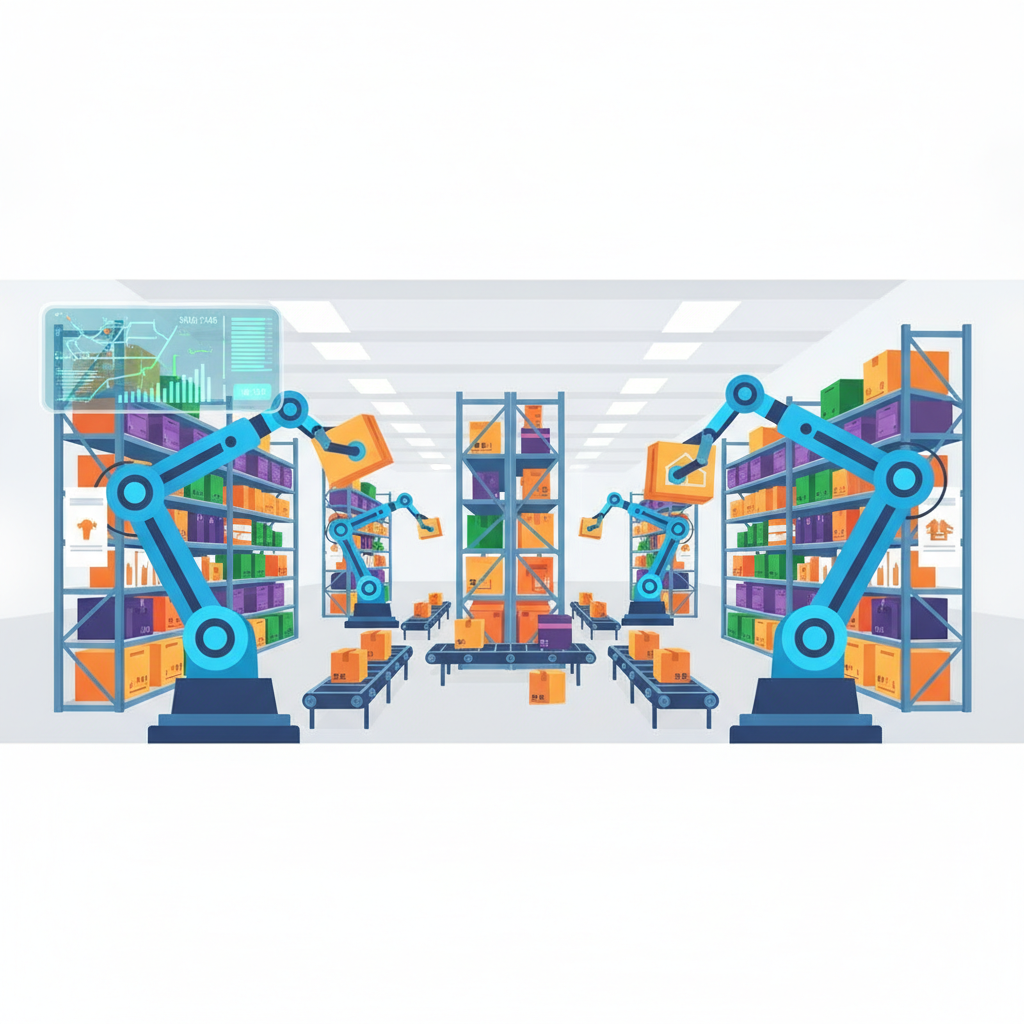
In the rapidly evolving world of e-commerce, merely selling products is no longer sufficient for achieving success and sustainability. Instead, managing backend operations, specifically inventory management, has become the cornerstone that determines a store's efficiency and its ability to fulfill customer orders effectively and profitably. The challenges faced by e-commerce store owners, such as tracking thousands of products, managing multiple warehouses, and avoiding stockouts or overstocking, demand smart and sophisticated solutions that go beyond traditional manual methods, which have proven ineffective in today's business environment.
Today, inventory management automation is not just a luxury but an absolute necessity for every e-commerce store aspiring to grow and expand, whether it's on Salla, Zid, or Shopify. This automation allows business owners to transform routine and time-consuming tasks into automated processes, freeing them to focus on growth strategies, marketing, and enhancing customer experience. Through this comprehensive article, we will delve into the concept of inventory automation, exploring how leading e-commerce platforms in the region and globally can help you achieve it, with a focus on benefits, tools, and best practices to ensure your store operates smoothly and with unparalleled efficiency.
Why Is Inventory Automation a Critical Necessity in E-commerce?
Imagine running a thriving e-commerce store on a platform like Salla or Zid, receiving hundreds of orders daily. If you are still relying on manual spreadsheets to track your inventory, you will quickly find yourself overwhelmed with errors, product shortages, and shipping delays, negatively impacting your store's reputation and customer loyalty. Inventory automation is the solution to these challenges, transforming inventory management from an operational burden into a competitive advantage that enables you to respond quickly to market changes and increasing customer expectations.
The reasons for the necessity of automation go beyond merely avoiding human errors. In a highly dynamic and competitive market, a store with an automated inventory system has a significant advantage in responding to demand, improving cash flow, and reducing storage costs. This automation ensures that inventory data is accurate and continuously updated, allowing you to make informed decisions regarding restocking, pricing, and promotional offers.
Furthermore, inventory automation allows you to significantly enhance the customer experience by reducing order cancellations due to product unavailability and accelerating the order preparation and shipping process. This, in turn, boosts customer trust and satisfaction, leading to repeat purchases and increased brand loyalty. Investing in inventory automation is an investment in your store's future and long-term success.
Challenges of Manual Inventory Management
E-commerce stores relying on manual inventory management face numerous challenges. Firstly, human errors: manual data entry can lead to inaccuracies in counting, recording, or updating, resulting in discrepancies between physical and recorded inventory. These errors can lead to selling unavailable products or overstocking slow-moving items, both of which harm profitability and the store's reputation.
Secondly, time and resource consumption: manually tracking inventory, from receiving goods to updating quantities after each sale, is time-consuming and labor-intensive, potentially diverting employees who could be utilized for more productive tasks. This wasted time translates into higher operational costs and limits the store's ability to scale rapidly.
Thirdly, lack of visibility and control: manual systems often lack the ability to provide comprehensive and immediate visibility into inventory across various sales channels, making it difficult to make quick and informed decisions regarding restocking or promoting products. This lack of visibility can also lead to stockouts for highly demanded products or overstocking for slow-moving items, both of which are extremely costly problems.
Strategic Benefits of Automation
Inventory management automation offers a wide range of strategic benefits that enhance the efficiency and profitability of your e-commerce store. Firstly, enhanced accuracy: automation systems significantly reduce human errors, ensuring that inventory data is precise and reliable. This means you will know exactly how many products you have available at any given time, minimizing the chances of selling non-existent products or losing sales due to incorrect inventory information.
Secondly, time and cost savings: by automating routine tasks such as quantity updates, shipment tracking, and generating reorder requests, stores can save a significant amount of time and human resources. These savings not only reduce operational costs but also allow employees to focus on higher-value tasks such as customer service, marketing, and product development. You can also reduce shipping costs by optimizing packing and packaging processes, as detailed in the article Shipping Costs: Reducing Them for Your Salla and Zid Store.
Thirdly, improved visibility and control: automated inventory systems provide real-time dashboards and detailed reports, giving you a comprehensive overview of your inventory performance. You can monitor inventory levels, track sales, and identify trends quickly, enabling you to make informed decisions regarding purchasing, pricing, and promotions. This strategic visibility empowers you to better forecast demand and optimize your store's cash flow.
Fundamentals of Automated Inventory Management in Salla, Zid, and Shopify
E-commerce platforms like Salla, Zid, and Shopify serve as the backbone for thousands of online stores in the Arab world and beyond. Each of these platforms offers a set of tools and features that facilitate inventory management, though with varying degrees of complexity and customization. Understanding these fundamentals is crucial for selecting the most suitable platform for your store and meeting its specific needs. To learn more about which platform is best for you, you can refer to the article Salla, Zid, and Shopify: Which is Best for Your Store?.
These platforms excel at providing user-friendly interfaces for managing products and inventory, where merchants can add new products, specify available inventory quantities, and set product options such as sizes and colors. However, their true power lies in their ability to automate many of these tasks, such as automatically updating inventory upon a sale, alerting merchants when stock levels drop to a certain threshold, and even integrating with external systems for warehouse management and shipping. These capabilities enable merchants to focus on growing their business rather than getting bogged down in routine inventory management details.
Maximizing the inventory management features of these platforms requires a deep understanding of how each works and how to customize them to fit your store's business model. Whether you run a small store with limited products or a large enterprise with complex inventory, the ability to automate inventory operations will be a critical factor in achieving operational efficiency and long-term success. In the following sections, we will delve into how each platform handles inventory management and the best practices for leveraging them.
Inventory in Salla: Features and Tools
Salla, one of the leading platforms in the Saudi and Gulf markets, offers robust and user-friendly inventory management tools suitable for small and medium-sized store owners. Merchants on Salla can easily add products, specify available quantities for each product and its options (such as colors and sizes). With every sale, the inventory quantity is automatically updated, reducing the need for manual intervention and preventing the sale of unavailable products.
Salla also provides a low stock alert feature, where merchants can set a minimum inventory threshold. When inventory reaches this limit, an alert is sent for reordering. This feature is vital for avoiding stockouts and ensuring popular products are always available. Additionally, Salla allows for inventory management of products with multiple options, where a separate quantity can be specified for each product option, offering greater flexibility in tracking.
Salla can also integrate with some external Point of Sale (POS) systems and inventory management applications through its app store, allowing for the unification of inventory data between the online store and physical warehouses, if the store operates a multi-channel sales system. These integrations expand Salla's basic capabilities, making it an attractive option for stores that require more comprehensive automation solutions.
Inventory in Zid: Advanced Features
Zid, a strong competitor to Salla in the Saudi market, also offers a comprehensive suite of flexible and powerful inventory management tools, suitable for stores with growing needs. Zid enables merchants to accurately manage inventory quantities, track product movement, and define inventory types (such as shippable products, digital products, or services). This flexibility in product categorization helps organize inventory effectively.
Zid provides advanced features such as multi-warehouse inventory management, which is an essential feature for stores with more than one storage location. This feature allows merchants to distribute their inventory across different warehouses and track each warehouse separately, facilitating shipping operations and improving delivery speed to customers. Zid also supports linking products with various options like sizes and colors, accurately tracking the inventory of each option separately.
Moreover, Zid offers a robust reporting and analytics system on inventory performance, allowing merchants to review best-selling and slowest-selling products, identify products that need restocking, and analyze inventory turnover rates. These vital reports help in making smart pricing decisions, as discussed in the article Product Pricing: Smart Strategies for Salla and Zid Stores, and optimizing purchasing strategies, thereby reducing storage costs and increasing profitability.
Shopify's Inventory Automation Options
Shopify is a leading global platform, known for its flexibility and scalability, making it an excellent choice for stores of all sizes, especially those looking to expand internationally. At its core, Shopify offers essential inventory management tools, such as quantity tracking, defining products with variants and assigning inventory to each variant, along with low stock alerts. However, Shopify's true strength lies in its extensive App Store, which features thousands of specialized inventory management applications.
Merchants on Shopify can choose from a wide range of advanced inventory management apps that provide features such as multi-location inventory management, demand forecasting using AI, automated purchase orders from suppliers, and omnichannel inventory management across various marketplaces. These applications enable stores to customize their inventory management solutions to precisely meet their complex needs, whether they manage their own warehouses or rely on third-party logistics (3PL) services.
Additionally, Shopify facilitates integration with shipping carriers and fulfillment services, allowing for automated order fulfillment and real-time inventory status updates once a product is shipped. This comprehensive integration makes Shopify an ideal platform for stores that require integrated and complex automation solutions, enabling them to manage their entire supply chain with high efficiency. For a comprehensive comparison of shipping platforms, you can read the article Shipping Companies: Comparing Prices and Services for Salla and Zid.
Effective Inventory Automation Strategies and Applications
To maximize the benefits of inventory automation, it is not enough to simply use the available tools; rather, well-thought-out strategies must be implemented to enhance operational efficiency and improve the store's overall performance. These strategies go beyond mere quantity tracking, extending to demand forecasting, optimizing inventory levels, and linking all points of the supply chain. Implementing these strategies ensures that your store is always ready to meet customer demands while maintaining the lowest possible costs.
Effective strategies begin with a deep understanding of customer behavior and purchasing patterns, allowing for accurate demand forecasts. They then move to using technology to implement these forecasts, such as setting up automatic reorder points and seamlessly managing inventory across multiple channels. The ultimate goal is to create an inventory ecosystem that operates as autonomously as possible, reducing manual intervention and freeing up resources to focus on strategic growth.
By adopting these strategies, e-commerce stores on Salla, Zid, and Shopify can transform from simply tracking inventory to proactive and intelligent inventory management. This transformation not only improves operational efficiency but also enhances the store's ability to compete in an ever-changing market and provides an unforgettable customer experience that leads to loyalty and sustainable growth.
Demand Forecasting and Reorder Point Management
Demand forecasting is the cornerstone of effective automated inventory management. By analyzing historical sales data, seasonal trends, promotions, and even external factors such as market events, stores can estimate future demand for their products with greater accuracy. Many advanced inventory automation systems rely on AI and machine learning algorithms to provide precise demand forecasts, helping to prevent stockouts or overstocking.
Based on these forecasts, stores can automatically set reorder points. A reorder point is a specific inventory level at which a new purchase order to suppliers is automatically triggered. For example, if a certain product takes 7 days to arrive from the supplier, and its average daily sales are 10 units, the reorder point might be 70 units (7 days × 10 units/day) plus a safety stock to mitigate risks. This automation ensures that products are always available without the need for constant manual monitoring.
Implementing this strategy requires integrating the inventory management system with sales data, and in some cases, with Enterprise Resource Planning (ERP) systems. This integration allows for a continuous cycle of forecasting, reordering, and inventory updating, which reduces costs associated with excess inventory and improves the store's cash flow. It also ensures that desired products are available to customers at the right time, enhancing their satisfaction and loyalty.
Real-Time Inventory Tracking
Real-time inventory tracking is one of the most crucial features offered by inventory automation systems. Instead of manually updating inventory at infrequent intervals, these systems update quantities instantly after each sale, receipt of new goods, or product return. This means that the figures displayed on the store's dashboard and available to customers are accurate and continuously updated, preventing the sale of unavailable products and improving the shopping experience.
Platforms like Salla, Zid, and Shopify rely on this feature as a core component of their default inventory management tools. As soon as a customer completes a purchase, the sold quantity is automatically deducted from the available inventory. If the store uses barcode scanners for receiving or shipping goods, these systems can integrate to automatically update inventory, significantly reducing human errors and saving valuable time.
The benefits are not limited to accuracy alone; they extend to the ability to make quick and informed decisions. With accurate real-time inventory data, stores can rapidly identify best-selling products, pinpoint slow-moving items that need promotions, and effectively respond to any unexpected fluctuations in demand. This level of visibility and control enables the store to continuously optimize its operational and marketing strategies.
Omnichannel Inventory Management
In the modern e-commerce era, stores are no longer limited to a single sales channel but expand to include multiple channels such as online stores, physical stores, social media platforms, and even major marketplaces like Amazon and Noon. Omnichannel Inventory Management becomes essential to ensure a seamless and consistent customer experience across all touchpoints.
This strategy involves linking all sales channels to a central inventory management system, so that inventory is automatically updated across all platforms as soon as a sale is made on any channel. For example, if a product is sold in your physical store, the quantity is automatically deducted from the available inventory in your Salla or Shopify store to prevent selling the same product twice. This integration prevents online stockouts while the product is still available in the physical store, or vice versa.
Many advanced Shopify apps, and some Salla and Zid solutions, offer powerful omnichannel inventory management capabilities. This not only ensures inventory accuracy but also improves the store's ability to fulfill orders from the nearest warehouse or physical store, reducing shipping costs and increasing delivery speed. This approach also enables stores to offer options like click and collect, enhancing the flexibility of the customer shopping experience.
Integration with Storage and Shipping Systems
The integration between an inventory management system and storage and shipping logistics is an integral part of comprehensive supply chain automation. When these systems are effectively integrated, a store can achieve unprecedented efficiency in order processing, error reduction, and accelerated delivery to customers. These integrations are essential for stores aiming to scale and provide an excellent logistical experience.
Warehouse Management Systems (WMS) that integrate with e-commerce platforms like Shopify, and in some cases with Salla and Zid via third-party apps, enable the automation of tasks within the warehouse. These tasks include: receiving goods, identifying storage locations, picking and packing orders, and real-time inventory updates. This integration ensures that inventory data is accurate not only at the store level but also at the warehouse level, reducing picking errors and increasing processing speed.
Furthermore, the inventory system can be directly linked with shipping companies, allowing for automatic generation of shipping labels, shipment tracking, and updating of order and inventory status as soon as a product is shipped. This linkage reduces manual intervention, improves the accuracy of order tracking for customers, and contributes to reducing shipping costs by selecting the best shipping options based on product size, weight, and destination. This comprehensive integration enhances the efficiency of the entire supply chain and significantly improves customer satisfaction.
Best Practices for Successful Inventory Automation Implementation
Simply adopting inventory automation tools does not guarantee success in itself. Rather, it requires implementing best practices that complement these tools and enhance their effectiveness. These practices include careful planning, team training, continuous review, and adapting to changes in the market and demand. A holistic approach to implementing inventory automation ensures that your e-commerce store on Salla, Zid, and Shopify maximizes its investment in these technologies.
Best practices begin with setting clear and specific goals for the automation process, such as reducing errors by a certain percentage, improving shipping speed, or lowering storage costs. Then, appropriate tools that support achieving these goals are selected. Following that, detailed planning for the implementation process takes place, including system integration, data migration, and thoroughly testing new processes before their full launch.
Adhering to these practices not only improves inventory management efficiency but also enhances the store's flexibility and ability to adapt to future challenges. Building a robust and reliable automated inventory system is a strategic investment that enables your store to grow and expand confidently in the competitive e-commerce market.
Team Training and Standardization of Procedures
Training the store's team on how to use new inventory automation systems is crucial for ensuring their success. Even the best systems will not be effective if employees do not know how to use them correctly. Comprehensive training should be provided to all involved individuals, from warehouse staff to the customer service team, to ensure they understand how the system works, how to input data, and how to handle potential issues.
In addition to training, procedures and processes related to inventory management must be standardized. This means developing clear and detailed documentation for all tasks, such as receiving goods, packing orders, and conducting inventory counts. Standardizing procedures ensures that everyone follows the same steps, which reduces errors and increases efficiency. For example, there should be a standardized process for handling returned products and how to update inventory after their receipt.
Employees should also be encouraged to provide feedback and suggestions on how to improve the system or processes. Those who interact with the system daily are best positioned to identify weaknesses or opportunities for improvement. Listening to their feedback and implementing necessary changes enhances system adoption and improves overall performance, leading to smoother and more effective inventory management.
Continuous Review and Improvement
Implementing inventory automation is not a one-time process; it is an ongoing journey that requires continuous review and improvement. Store owners should regularly review the performance of their inventory management system, analyzing reports and data to identify strengths and weaknesses. These reviews may include examining inventory accuracy, order processing speed, storage costs, and inventory turnover rates.
Based on the results of these reviews, necessary adjustments and improvements should be made. This might involve adjusting reorder points, changing supplier strategies, or even exploring new applications or integrations. For example, if inventory reports show that a particular product frequently runs out of stock, it may be necessary to adjust its reorder point or seek an alternative supplier that offers faster shipping.
Stores must also be prepared to adapt to market changes, such as the introduction of new products, shifts in consumer behavior, or peak seasons. Flexibility in adjusting your inventory system to accommodate these changes is key to continuity and success. Continuous improvement ensures that your inventory automation system remains effective and up-to-date with the latest developments, supporting your store's long-term growth.
Preparing for Seasons and High Demand
The ability to handle high-demand seasons, such as White Friday, holidays, or special events, is a critical indicator of an inventory management system's efficiency. These periods require careful and precise planning to ensure that products are available in sufficient quantities and to avoid stockouts that could lead to significant lost sales and customer frustration.
Preparations for peak seasons include: analyzing past sales data for those periods to identify best-selling products and forecast required quantities, increasing inventory for key products well in advance, and coordinating with suppliers and shipping companies to ensure smooth supply chains. Advanced inventory automation systems can assist in this process by providing accurate demand forecasts and generating automatic purchase orders based on these predictions.
It is also essential to ensure that the store's infrastructure, whether on Salla, Zid, or Shopify, can handle the increase in order volume, and that the team is trained and ready to process the additional workload. Good preparation for peak seasons not only ensures increased sales but also enhances the store's reputation and its ability to provide excellent service even under pressure, leading to long-term customer loyalty.
Conclusion: The Future of E-commerce Lies in Smart Automation
In conclusion, it is clear that inventory management automation is no longer just a complementary option; it has become a fundamental pillar for the success of any e-commerce store aspiring to grow and sustain itself in the constantly changing digital commerce landscape. By adopting the right tools and strategies, store owners on platforms like Salla, Zid, and Shopify can transform traditional inventory management challenges into opportunities to enhance operational efficiency, reduce costs, and improve the customer experience unprecedentedly.
Automation enables stores to transcend the limitations of manual methods that are prone to errors and consume time and resources. Instead, it provides them with the ability to accurately track inventory in real time, effectively forecast demand, seamlessly manage products across multiple sales channels, and connect all aspects of the supply chain from suppliers to customers. This ability to work smarter, not harder, is what distinguishes leading stores and gives them a true competitive advantage.
Therefore, the next step for any store owner serious about achieving success is to evaluate their current inventory management system and identify areas that can be improved through automation. Whether it's by leveraging built-in features on their platform, exploring third-party applications, or investing in comprehensive ERP solutions, the path towards the future of e-commerce inevitably passes through intelligent inventory automation. Invest today in automating your inventory to ensure a prosperous and successful tomorrow for your store.