



In the fast-paced world of e-commerce, many beginner merchants believe that launching the store and adding products is the finish line, but the reality is that this is just the starting point. Real success doesn't depend on guessing or intuition — it depends entirely on the language of numbers and data. When you manage your store via leading platforms like Zid or Salla, you possess a strategic treasure of information that updates around the clock, and this treasure is represented in the sales and performance reports that accurately reflect your business health.
Reading sales reports isn't just reviewing profit and loss numbers — it's a deep diagnostic process resembling a comprehensive medical examination of your online store. Through these reports, you can understand your customer behavior, identify products achieving you the highest profit margin, and know times when purchase desire increases. Ignoring this data means you're driving your car in a dark road with eyes blindfolded, making you susceptible to making wrong marketing decisions that may cost you your entire budget without achieving any tangible return.
The biggest challenge facing store owners today isn't in how to get data — Zid and Salla platforms provide advanced and easy-to-use dashboards — but the challenge lies in how to convert these silent numbers into strategic decisions speaking of success. In this comprehensive article, we'll take you on a detailed step-by-step journey to learn the art of sales analysis and how to decode reports in your store, so you can finally double your profits and reduce financial waste smartly and professionally.
The Importance of Sales Analysis in E-commerce
Sales analysis is the backbone of any online store seeking growth and sustainability in a fiercely competitive market. When you start reading your Salla or Zid store reports regularly, you move from the random management stage to the data-driven strategic management stage. This shift allows you to understand the big picture of your business — clarifying money paths precisely, where it comes from and where it goes, helping you improve your cash flows and avoid sudden financial crises that bring down many emerging projects.
Additionally, sales analysis helps you distinguish between vanity metrics and real performance indicators. For example, you might rejoice at increased store visits resulting from a costly advertising campaign, but if these visits don't translate into actual sales, these numbers become worthless. Here the role of deep analysis comes in to discover the malfunction in the customer path, and work on Improving Conversion Rate to ensure maximum benefit from every visitor entering your store, converting them from a mere browser into a loyal buyer.
The benefits you reap from sales analysis exceed just increasing profits — they also include dramatically improving user experience. Through data, you can know pages visitors leave from, their preferred payment methods, and even devices they use for shopping. Based on this information, you can adapt your store to precisely suit your audience preferences. Here are the most important benefits you'll get from continuous analysis of your store reports:
- Discovering hidden sales opportunities: Knowing products that can be combined to increase order value.
- Improving marketing budget: Directing advertising money toward channels bringing real customers and not just visits.
- Predicting trending seasons: Early preparation for seasons witnessing heavy demand based on previous years' data.
- Identifying customer segments: Knowing who your best customers are to customize offers and discounts for them.
The Basic Indicators in Zid and Salla Reports
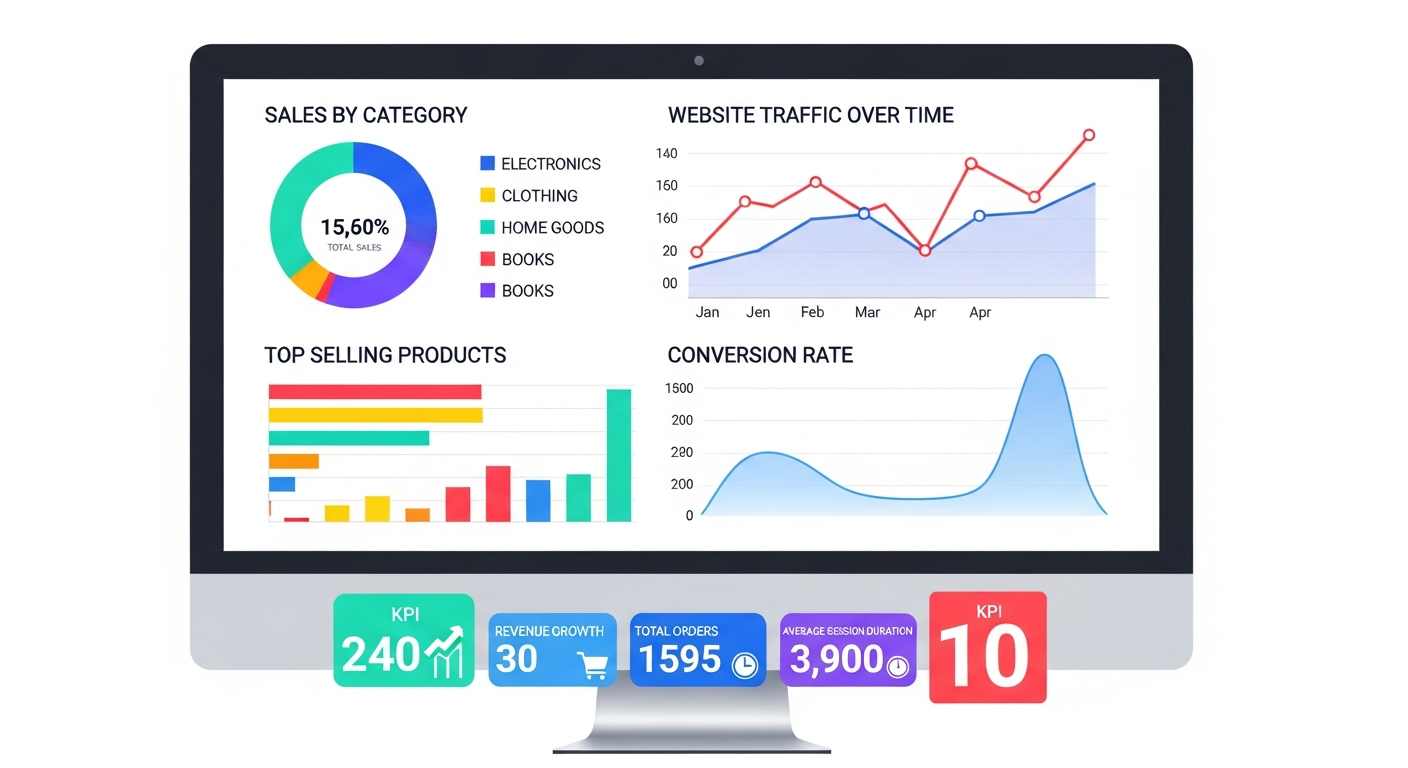
When you open the dashboard in your Zid or Salla store, you'll face a large group of charts and numbers that may seem complex at first glance. The secret here lies in not trying to track everything at once, but focusing on the Key Performance Indicators (KPIs) that directly affect your business health. These indicators represent the live pulse of your store, telling you whether you're going in the right direction or need to correct your course immediately to avoid losses.
Among the most important of these indicators is total revenue, but it alone isn't enough to evaluate success. You should also look at net profit after deducting product costs, shipping fees, payment gateway commissions, and marketing costs. Salla and Zid platforms provide detailed financial reports helping you accurately calculate these costs, giving you a clear picture of the actual profit margin for each product, protecting you from the trap of high sales with low or zero profits.
Moreover, you should track customer engagement indicators with your store, like the average time a visitor spends on the site and the number of pages they browse per session. If you notice visitors leaving the store within a few seconds of entry, this is an alarm bell indicating a problem that may be in site load speed, user interface design, or even unclear product images and descriptions. Let's dive deeper into some vital indicators you should never overlook.
Sales Volume and Average Order Value
Sales volume is the clearest indicator reflecting the number of orders successfully executed during a specified period. Monitoring sales volume daily, weekly, and monthly helps you understand the general pattern of your business. Do sales increase on weekends? Do they decrease in mid-month? These patterns help you smartly plan your advertising campaigns, launching promotional offers at times when your customers are most ready to buy, doubling the effectiveness of your marketing efforts.
The second indicator closely linked to sales volume is Average Order Value. This indicator tells you the average amount the customer spends each time they shop from your store. To calculate this indicator, all you have to do is divide total revenue by total number of orders. For example, if your revenue is 10,000 riyals from 100 orders, the average order value is 100 riyals. Raising this indicator is one of the fastest ways to increase your profits without needing to pay more money to acquire new customers.
To improve average order value in your store, you can rely on smart strategies provided by Zid and Salla platform settings. Among the most prominent of these strategies is using Cross-Selling techniques, where you display complementary products to the product the customer chooses. For example, if the customer is buying a smartphone, you can offer a protective cover and fast charger as suggested products before completing payment, encouraging them to add more items to their cart and easily raise the total order value.
Conversion Rates and Visitor Behavior
Conversion Rate is the percentage of visitors who successfully completed the purchase out of the total number of visitors who entered your store. This indicator is the golden criterion for how convincing your store is to customers. In e-commerce in the Arab region, good conversion rates usually range between 1% to 3%. If your store receives 1,000 visitors daily and achieves 20 orders, your conversion rate is 2%. If this rate is very low, it means you're paying money to bring visitors but there are obstacles preventing them from buying.
To understand the reasons for low conversion rate, you must carefully study visitor behavior through Sales Funnel reports. These reports clarify where potential customers leak. Do they exit from the product page? Or do they add products to cart then leave? Or do they reach the checkout page and retreat at the last moment? Identifying the leak location accurately enables you to put appropriate solutions in place, like simplifying the checkout form, providing faster shipping options, or adding diverse payment gateways suiting everyone.
Among the most prominent problems you'll discover when analyzing visitor behavior is the shopping cart abandonment phenomenon. Many customers add products to cart but don't complete the order for several reasons, including surprise shipping costs or desire to compare with other stores. Here you should activate the Abandoned Carts recovery tools available on Salla and Zid, which send automatic reminder messages via email or SMS, with a simple discount code to encourage the customer to return and successfully complete the purchase.
How to Read Product and Inventory Reports
Sales analysis isn't limited only to the financial side — it extends to include product and inventory management, the sensitive nerve of any online store. Product reports on Zid and Salla platforms give you a panoramic view of each product's performance separately. Through these reports, you can know products attracting the largest number of views, and those achieving the highest conversion rate, helping you make decisive decisions about product pricing, updating their images, or even modifying their descriptions to be more attractive and convincing to customers.
The other important aspect is inventory reports, which protect you from two main problems: Stockouts and Dead Stock. Stockouts for best-selling products mean direct loss in profits and distortion of your store reputation in front of customers who may head to competitors. As for dead stock for products that don't sell, this means freezing cash liquidity that could have been invested in more profitable products, plus continuous storage costs eating from your net profit margins.
Therefore, periodic and continuous follow-up of inventory reports is an indispensable necessity. Through modern e-commerce platforms, you can set up automatic alerts when a certain product's inventory reaches a defined minimum, giving you enough time to contact suppliers and reorder. If you want to master this aspect and avoid costly mistakes, we recommend reviewing effective Inventory Management strategies guaranteeing you a continuous product flow and fast response to your customer orders without delay.
The Best and Worst Selling Products
The best-selling products report is the favorite of all merchants — it highlights the shining stars in your store. These products lead your business growth and provide you with cash liquidity. When identifying these products in the Salla or Zid dashboard, you should exploit their success to the maximum. You can place these products on the store's home page, use them in retargeting advertising campaigns, and always ensure sufficient quantities are available in inventory to meet their continuous demand.
On the other side comes the worst-selling products report, a report that may be annoying but carries very valuable lessons. You must objectively study these products to know the reasons for their stagnation. Is the price high compared to competitors? Is the image quality poor and doesn't clearly show product details? Does the product itself not solve a real problem for the customer? Answering these questions will help you either improve product display to increase its sales, or make the brave decision to permanently stop selling it and replace it with another more in-demand product in the market.
To smartly get rid of stagnant products, you can use the Product Bundling strategy. For example, if you have a slow-selling product, you can combine it with one of your best-selling products in one bundle at an enticing and exclusive price. This dual strategy is very useful — it helps you get rid of accumulated inventory and recover your capital, while simultaneously raising the average order value for the customer who feels they got an excellent deal and additional value, enhancing their loyalty to your store.
Practical Steps to Convert Data Into Successful Decisions
Data itself doesn't make success — actions and decisions based on this data are what make the real difference. After you've learned how to read and understand the various reports in your Zid or Salla store, the most important step is crafting an executable action plan. The first step in this plan is clearly defining goals based on current numbers. For example, if your conversion rate is 1%, your realistic goal for next month should be raising it to 1.5%, not jumping immediately to 5% with unrealistic dreams.
The second step is starting to conduct systematic A/B Testing. Don't rely on big random changes that may confuse customers and destroy sales. Instead, change just one element each time and monitor its impact on the reports. Try changing the "Add to Cart" button color, modifying the promotional offer wording, or adding professional images for a certain product, then compare the product's performance before and after the modification. This scientific method ensures you accurately know what your audience prefers and avoids making decisions based on wrong assumptions.
To ensure continuity of success and not interrupting store performance monitoring, you must build a strict routine for reviewing reports. This routine divides analytical tasks into specific time periods preventing data accumulation and making the analysis process an integral part of your daily store management. Here's a suggestion for an analytical routine you can follow and apply easily in your store:
- Daily Routine: Reviewing daily sales volume, ensuring no pending orders or payment gateway problems, and checking low inventory alerts.
- Weekly Routine: Analyzing advertising campaign performance, comparing sales with last week, and identifying products that witnessed a sudden surge in demand.
- Monthly Routine: Extracting the comprehensive profit and loss report, reviewing monthly conversion rates, and evaluating overall store performance to put a marketing plan for the new month.
Conclusion: Continuity is the Secret of Success in E-commerce
In closing this knowledge journey about sales analysis, we must emphasize a constant truth in the e-commerce world: success isn't a stroke of luck — it's a natural result of listening well to what your store data tells you. Reading reports on Zid and Salla platforms isn't a task you do once when launching the store and ignore afterward — it's a continuous commitment and ongoing process of learning, improvement, and development. Markets change, consumer behaviors change, and numbers are your only compass to stay in the competition circle.
Modern e-commerce platforms like Salla and Zid have provided you with powerful analytical tools that were in the past exclusive to large companies with huge budgets. Today, through your computer screen or even your smartphone, you can monitor your store pulse moment by moment, identify strengths to reinforce, and discover weaknesses to address before they worsen. Maximum benefit from these advanced dashboards puts you in a position of strength allowing you to outperform your competitors who still rely on intuition and guessing in managing their business.
Finally, make data analysis a firmly rooted culture in managing your commercial project. Don't fear low numbers or negative reports — consider them guiding messages and early signs lighting the path to improvement for you. Start today by allocating specific time to review your store reports, applying the practical steps we discussed, and watch how these silent numbers will transform into ascending growth in your sales, an increase in your profits, and sustainable success for your brand in the thriving e-commerce market.