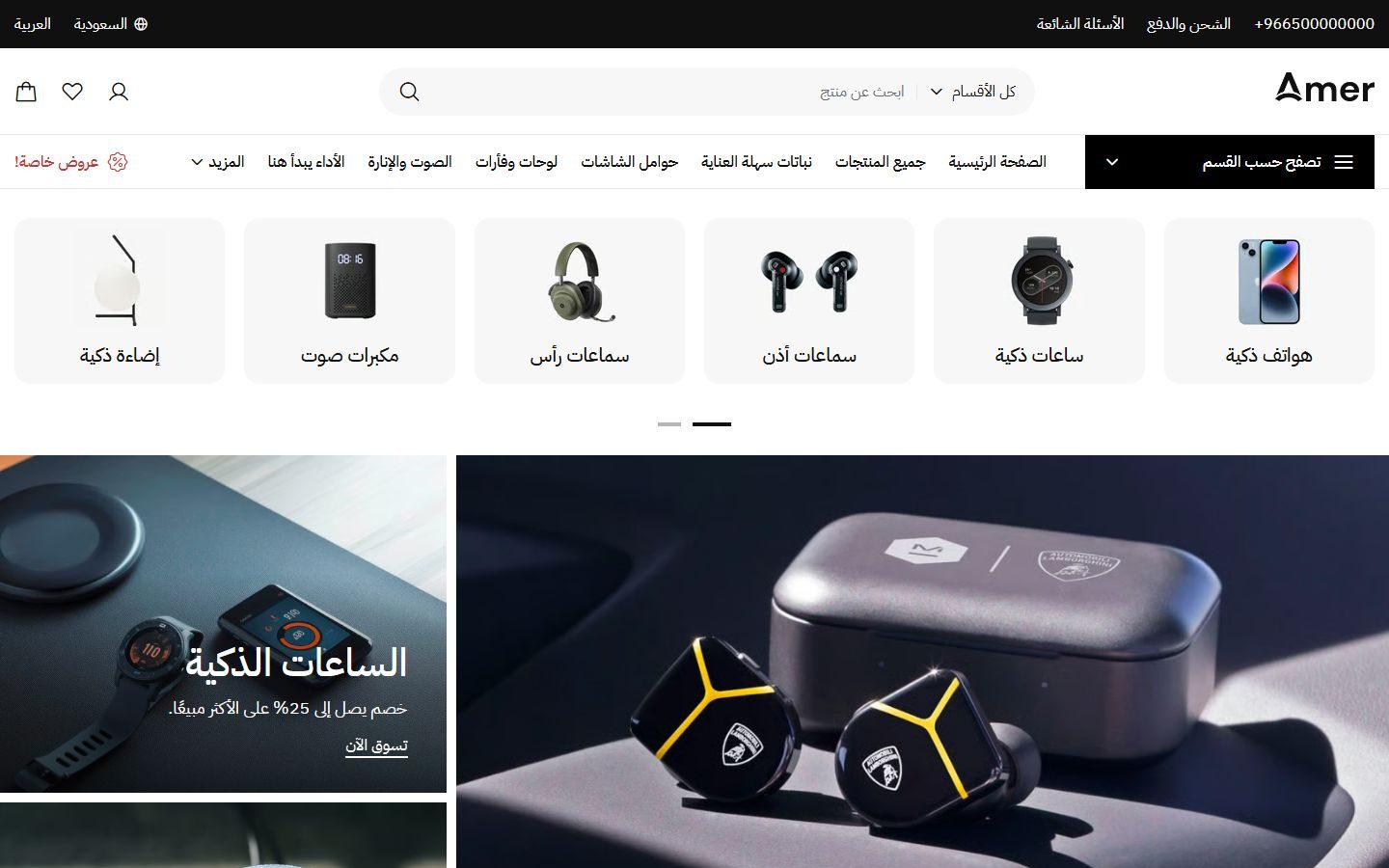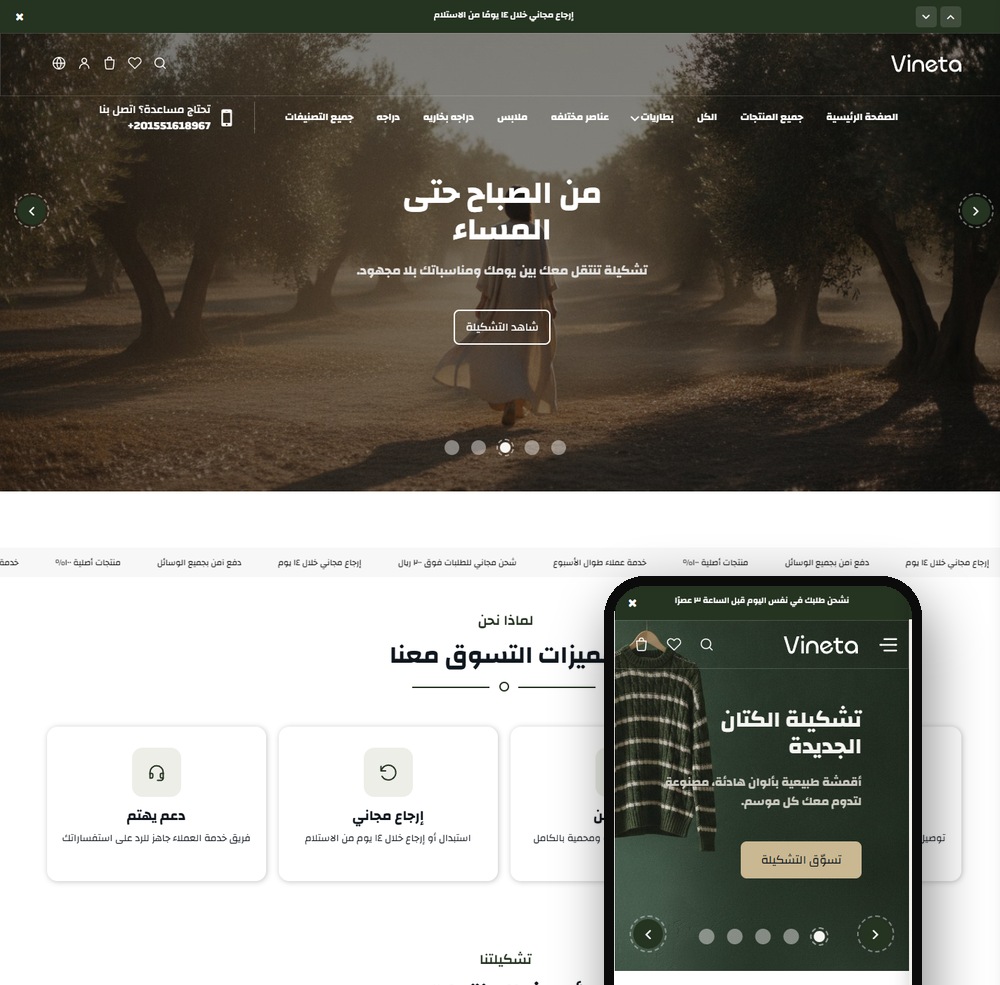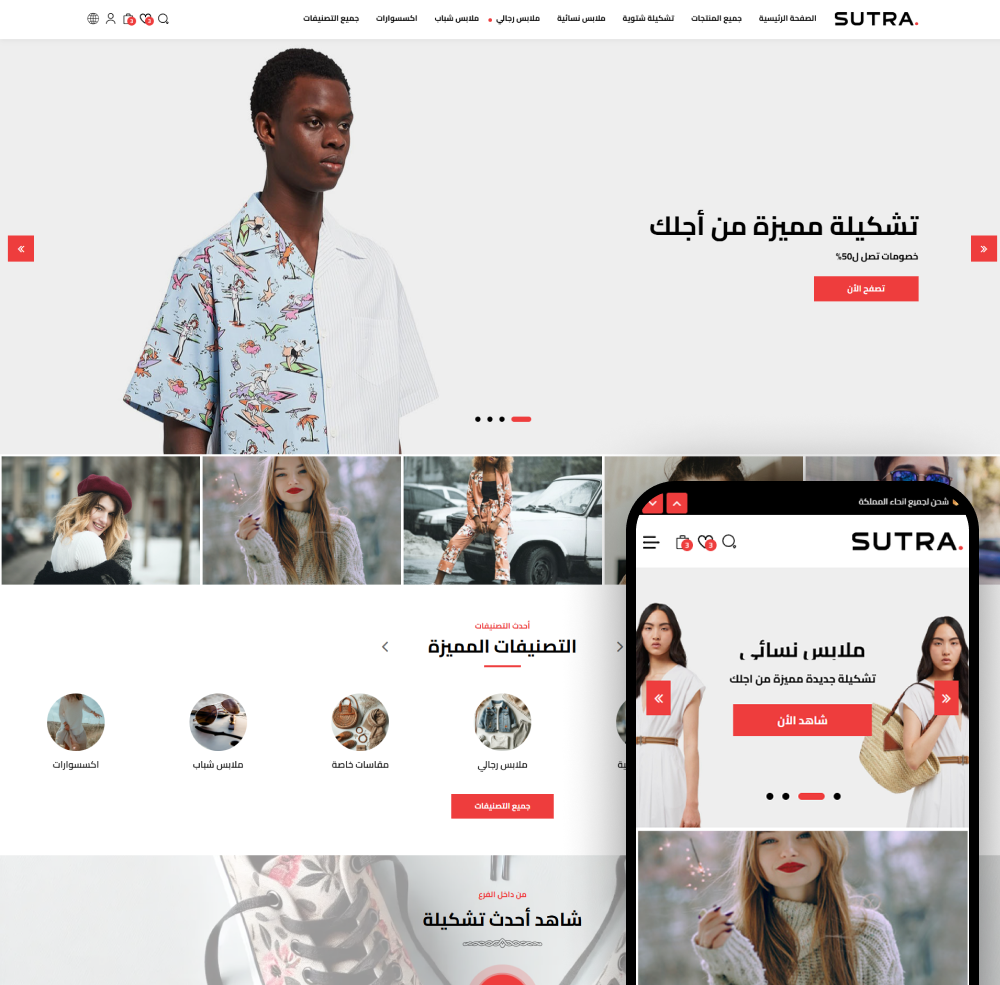




In the fast-paced e-commerce world, the customer lacks a basic advantage available in traditional stores, which is the ability to touch the product, examine it, and feel its materials before making the purchase decision. Here the supreme importance of product photography emerges, where the image becomes the eye through which the customer sees your product, and the silent representative speaking on behalf of your goods quality and brand professionalism. The online shopper makes their initial decision to stay in your store or leave it within a few seconds based on the first visual impression, making the investment in high-quality images not just a cosmetic option, but an inevitable necessity to ensure sales continuity and build a loyal customer base.
For merchants in the Arab world, leading platforms like Zid and Salla have provided excellent technical infrastructure and smooth user experience to establish online stores with all ease. But the visual content uploaded on these platforms remains the merchant's responsibility primarily. However elegant and fast your store design is, bad or dark product images will give a negative impression pushing the customer to doubt the store's credibility. In this comprehensive guide, we'll dive into the depths of product photography art, and offer you practical strategies and applied steps ensuring you display your products in the most beautiful way, so you can attract customer attention and convert visits into confirmed sales in your Salla or Zid store.
The Importance of Professional Product Photography on Zid and Salla Platforms
Professional product photography is considered the cornerstone in the success of any business project relying on online selling — it transcends being just documentation of the product's shape to be a powerful and effective marketing tool. When the customer browses your Zid or Salla store, they look for evidence and signals confirming to them that they're making the right decision by spending their money here. Clear professional images highlighting the finest product details play this role excellently, where they convey an implicit message to the customer that this store cares about quality and respects its customers to the point of providing the best possible visual experience for them.
Moreover, attractive images contribute to noticeably reducing return rates and complaints. When the image matches reality and displays the product's true colors and dimensions accurately, the customer receives exactly what they were expecting and what they saw on their phone or computer screen. This match between expectation and reality reduces disappointments that may push the customer to request product return, saving the Zid and Salla merchant a lot of operational costs and administrative effort associated with return processes and customer service.
And we can't ignore the role of professional images in enhancing the brand's visual identity and distinguishing it from competitors in the crowded market. By using a unified photography style, whether in terms of background colors, capture angles, or lighting quality, your brand begins to form a special visual fingerprint in the customer's mind. This visual consistency makes your store look like an integrated professional institutional entity, making it easier for customers to remember your store and return to it again when needing similar products in the future.
Building Trust with the Customer and Enhancing Credibility
Trust is the most valuable currency in the e-commerce world, and without it no sale can be completed however tempting the price. In online stores, high-quality images work as a bridge connecting between the store and the customer, where they compensate for the absence of physical interaction with the product. When you provide multiple images of the same product, including different angles and close-up shots (Zoom) showing fabric texture, stitching quality, or manufacturing precision, you tell the customer with complete transparency: we trust our product quality and have nothing to hide from you.
Let's imagine a customer searching for a luxury leather bag in your store on Salla platform. If they find just one image, with dim lighting, and a distracting background, they will feel hesitant and may think the bag is fake or of poor quality. Conversely, if they find a collection of bright images showing the bag from the front and back, a close-up of the zipper type used, another for the interior lining, and an image clarifying the bag size when worn, their trust level will rise greatly. This visual transparency removes the fear of the unknown barrier and pushes the customer to make the purchase decision with reassurance.
Also, using real product images instead of relying on ready stock photos from suppliers adds another layer of credibility. Today's consumer has become extremely smart and easily distinguishes between repeated images spread across thousands of stores and original images taken specifically for your store. Your investment in capturing real images, even if simple in your beginnings, proves to customers on Zid and Salla that you have real inventory and that you run a serious business worthy of their trust and money.
The Role of Images in Raising Conversion Rates and Sales
Conversion rate is the real measure of any online store's success, expressing the percentage of visitors who already completed the purchase. Attractive and meticulous images are considered one of the strongest motivators pushing visitors to click the "Add to Cart" button. The good image arouses desire, stimulates emotions, and creates an urgent need in the customer to own this product. You can review our guide on Conversion Rate: How to Double Your Store Sales on Zid and Salla to understand the close relationship between comprehensive user experience and increasing profits.
Many online marketing studies have proven that adding zoom feature for images and providing 360-degree product viewing can increase sales by noticeable percentages. On Zid and Salla platforms, you can benefit from these features by uploading high-resolution images allowing the customer to examine the finest details. When the customer feels they can examine the product as if it were in their hands, the likelihood of them abandoning the shopping cart decreases significantly, and the chances of completing the order and direct payment increase.
Additionally, image A/B Testing plays a pivotal role in maximizing sales. You may discover through analyzing your store data that a lifestyle image of the product in use brings more sales than a product image on a pure white background, or vice versa depending on the nature of your customer segment. Continuous updating of images based on buyer behavior, and monitoring each product's performance, ensures you maintain an ascending sales curve in your store, making your photography strategy a basic engine for financial growth.
The Golden Rules for Photographing Your Online Store Products
To get product images rivaling those in global stores, a set of golden rules governing the photography process from start to end must be followed. The first of these rules is prior planning for the photo session. Photography shouldn't be a random process relying on chance — a list of products to be photographed should be defined, necessary equipment prepared, and the appropriate time chosen if relying on natural light. This organization saves a lot of time and effort and ensures you come out with satisfactory and consistent results.
The second rule is maintaining visual consistency across all store pages. All products should look as if they belong to the same family, by unifying product sizes within the image frame, using the same lighting degrees, and the same background types. When the customer browses your Zid or Salla store and finds images at randomly varied sizes and lighting, that distracts their attention and reduces the brand's perceived value. Consistency is what gives your store a professional and eye-comforting character.
The third rule is focusing on the product as the sole hero of the image. Although adding some accessories or aesthetic elements may add an artistic touch to the image, extreme caution must be taken so these elements don't overshadow the basic product you're selling. The viewer's eye should be drawn immediately to the product, and any additional elements in the background should be mere tools to highlight the product's size or usage method without causing any confusion or distraction for the customer about what's exactly displayed for sale.
Appropriate Lighting and How to Smartly Leverage It
Lighting is considered the secret of any photographic image's success, and in product photography, it's the dividing element between the dull image and the professional life-filled image. The first and most economical option for beginners is relying on natural light. The best way to leverage sunlight is placing the photography table near a large window allowing bright but indirect light entry. Direct strong light creates sharp and annoying shadows, so it's recommended to use a light white curtain to diffuse the light (Diffuser) and make it soft and balanced on the product surface.
If you face difficulty relying on sunlight due to weather fluctuations or unavailability of daytime, moving to artificial lighting becomes necessary. It's not required to buy expensive studio equipment to start — you can use white LED bulbs (at a color temperature close to 5500 Kelvin to resemble daylight). It's important to use at least two light sources, one from the right and the other from the left, to reduce shadows and highlight product details from all sides equally.
To more professionally control shadows, you can use Reflectors. Even if you don't have professional reflectors, you can use a white foam board or a cardboard piece covered with aluminum foil and place it opposite the light source. This simple reflector will bounce the light falling on it toward the dark parts of the product, reducing shadow intensity and giving the image excellent depth and clarity — a technique professionals use that makes a huge difference in the quality of images uploaded on Zid and Salla.
Choosing Backgrounds and Angles That Highlight Details
Pure White Background is the golden standard and most common in e-commerce, and it's the preferred on platforms like Zid and Salla because it fits any store design and prevents any distraction of customer attention. The white background highlights the product's true colors and details clearly. However, product photography isn't limited to white backgrounds only; Lifestyle Photos showing the product in its natural environment are very essential to create an emotional bond with the customer and help them imagine the product's shape in their daily life.
Alongside the background, the compatibility between the image and written text plays an important role in persuasion. You can read Product Descriptions: Secrets of Writing Texts That Sell on Zid and Salla to learn how to integrate attractive descriptive text with expressive images. If the description refers to stitching durability in an athletic shoe, there should be a very close-up image (Macro) clearly showing the stitching to confirm the credibility of what's written.
As for photography angles, you should vary them to cover the entire product. The frontal angle at eye-level is the basis, followed by the 45-degree angle which gives a three-dimensional aspect to the product and clarifies its depth. The top-down photography angle (Flat Lay) is also very excellent for photographing folded clothes, cosmetics, or bundles consisting of several pieces. Providing this diverse mix of angles spares the customer from asking repeated questions and speeds up the purchase decision-making process.
Inexpensive Tools and Equipment to Start Product Photography
Many beginner merchants believe that product photography requires a huge budget to buy professional cameras and specialized lenses, but this belief is completely wrong in our current era. Modern smartphones have amazing cameras able to capture ultra-clear and ultra-high resolution images more than enough to display products in online stores. The secret isn't in the camera as much as it's in how to use it and understand lighting and composition basics. Using your current smartphone, you can start immediately without any exorbitant additional costs.
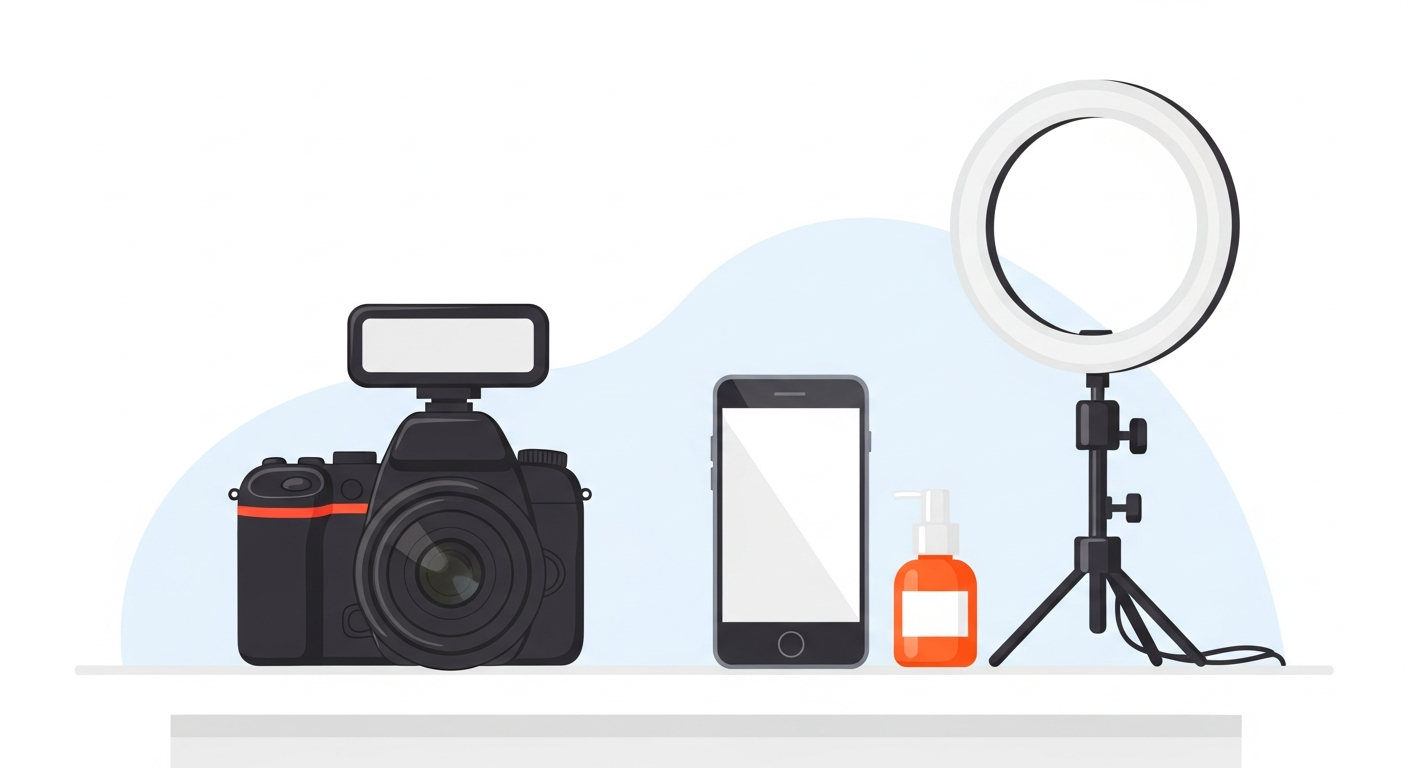
Among the most important inexpensive tools you should invest in is the Tripod. The tripod ensures complete stability of the camera or phone, preventing vibrations leading to image blur, especially when shooting in non-ideal lighting conditions. Also, using the tripod helps you fix the photography angle for all products, achieving the visual consistency we discussed earlier. Excellent tripods are available at affordable prices in various stores.
Another wonderful and budget-friendly tool is the Light Tent or Lightbox. This small foldable box comes equipped with built-in LED lighting and multi-colored backgrounds, and it's ideal for photographing small and medium products like watches, jewelry, perfumes, and small electronics. The lightbox provides you with an isolated environment with evenly distributed lighting, making it easier for you to capture images with pure white backgrounds without needing deep experience in lighting engineering or complex image editing.
Improving and Preparing Images to Suit Zid and Salla Interface
After finishing capturing wonderful images of your products, comes an extremely important step which is improving and preparing these images before uploading them on Zid and Salla platforms. The common mistake many fall into is uploading images at their original huge size, leading to severe slowness in store page loading. Loading slowness is the deadliest enemy of e-commerce, leading to raised bounce rate and store ranking decline in search engines. So images must be compressed and their file sizes reduced without sacrificing their visual quality.
To achieve the best result and an attractive display for your store, we recommend reviewing Store Design: Your Guide to Improving Your Store Interface on Salla and Zid where prepared images play a basic role in highlighting the beauty of the chosen theme. The appropriate file format should be chosen; JPEG format is considered excellent for photographic images because it provides a wonderful balance between image quality and file size. Recently, WebP format has become the modern best standard for web images, providing high compression while maintaining image details amazingly, and it's widely supported in modern platforms.
Moreover, image dimensions (Aspect Ratio) should be unified for all products to avoid the product grid appearing disorganized. Square dimensions (1:1) like 1000×1000 pixels are considered standard and ideal for most stores, fitting perfectly with computer displays and mobile phone apps. Use simple image editing programs to crop images and center the product within the frame, and ensure leaving equal white space (margins) around the product to make it look comfortable to the eye and professional when browsing.
Conclusion: Your Investment in Images Is an Investment in Your Success
In closing this guide, it must be emphasized that product photography isn't just a technical step you do to fill the gaps in your online store, but the visual communication language you speak with your customers. In the competitive e-commerce environment, especially for stores built on leading platforms like Zid and Salla, high-quality images are considered the decisive difference between the store achieving modest sales and the store growing and continuously expanding. We've proven how good lighting, thoughtful angles, and visual consistency can convert a regular product into a highly desired commodity.
Always remember to start with what's available to you. Don't let the lack of professional equipment stand as an obstacle in front of launching your store. Your smartphone, with good window light, and a simple white background, can produce images rivaling those in major stores if you apply the golden rules we reviewed. As your sales develop and your profits increase, you can gradually invest in better lighting equipment, or even contract professional photographers to raise your brand's visual identity level to new horizons.
Finally, make customer experience your compass in every image you capture. Always ask yourself: does this image answer the customer's questions? Does it highlight the product's beauty and quality honestly? Does it encourage them to buy with confidence? If the answer is yes, you're on the right path toward building a successful and trusted online store. Continue experimenting, test different types of images, and monitor customer interaction to continuously develop your visual strategy, ensuring your Zid or Salla store leadership and excellence in the Arab e-commerce market.